The Revolution is Here

Renzo Novatore Arcola

“History, materialism, monism, positivism, and all the “isms” of this world are old and rusty tools which I don’t need or mind anymore. My principle is life, my end is death. I wish to live my life intensely for to embrace my life tragically.

You are waiting for the revolution? My own began a long time ago! When you will be ready (God, what an endless wait!) I won’t mind going along with you for awhile. But when you’ll stop, I shall continue on my insane and triumphal way toward the great and sublime conquest of the nothing! Any society that you build will have its limits. And outside the limits of any society the unruly and heroic tramps will wander, with their wild & virgin thoughts–they who cannot live without planning ever new and dreadful outbursts of rebellion!

I shall be among them!

And after me, as before me, there will be those saying to their fellows: “So turn to yourselves rather than to your Gods or Politicians. Find what hides in yourselves; bring it to light; show yourselves!”

Because every person; who, searching his own inwardness, extracts what was mysteriously hidden therein; is a shadow eclipsing any form of society which can exist under the sun! All societies tremble when the scornful aristocracy of the tramps, the inaccessibles, the uniques, the rulers over the ideal, and the conquerors of the nothing resolutely advances.

So, come on iconoclasts, forward!

“Already the foreboding sky grows dark and silent!”

–Renzo Novatore Arcola, January, 1920

Renzo was a self-taught anarchist, who helped fight the fascist in Italy during the 1920s–he did this on his own terms as a man, not some apparatus of the state. You can find more of his work and poetry in “Toward the Creative Nothing.”  What I find beautiful about his work is the hope and enthusiasm that he eposes about the permanent struggle against society. His writings seize on the core struggle to have sovereignty over one’s life, insisting that we are not to be owned by anyone other than ourselves, and that we must manifest that for ourselves in the world. You can feel Nitcheze’s influence bleed through his writing, demanding us to will to power ourselves to infinity. Through demanding that no one own our ideals, morals, or dictate to us what is right or wrong; insisting that that world we live in is the one of our choice.

Renzo understood that the revolution was something to be demanded, manifested, and taken for oneself. If you want to be free–Free in the truest, greatest, and deepest sense of the word

THAN GO TAKE IT!

“Anarchy is not a social form, but a method of individuation. No society will concede to me more than a limited freedom and a well-being that it grants to each of its members. But I am not content with this and want more. I want all that I have the power to conquer. Every society seeks to confine me to the august limits of the permitted and the prohibited . But I do not acknowledge these limits, for nothing is forbidden and all is permitted to those who have the force and the valor.

Consequently, anarchy, which is the natural liberty of the individual freed from the odious yoke of spiritual and material rulers, is not the construction of a new and suffocating society.’ It is a decisive fight against all societies — christian, democratic, socialist, communist, etc., etc. Anarchism is the eternal struggle of a small minority of aristocratic outsiders against all societies which follow one another on the stage of history.”

Anarchism seeks to display and oppose all relationships of power; from the overt and open forms of power; to the most hidden and sinister ones too. This is the philosophy of liberty; for freedom needs to protect no one, nor can it exist under conditions where anyone is exploited. Anarchist understand that liberty is not just a party slogan of vacuous feelings; it is a philosophical maxim and a categorical imperative from upon which a better world can be advanced.

However, the demand for freedom is something that each and every individual needs to discover for themselves–you must seek to be free from the dark of the cave for yourself.

There must come a time in one’s life where the choice is made to reject toiling under the yoke of another man’s plow. One needs to look in the mirror and demand that their life is no longer going to be dictated by others for any reason other than choices of their own. To own one’s body and mind wholly; to own oneself entirely is the philosophical praxis of anarchism, and the path towards a better world.

Bitcoin and Crypto-Anarchy

I explained in a previous post that bitcoin and the internet are ideological apparatuses that are explicitly anti-statist, and anti-capitalist. Within both the internet and bitcoin are modes to liberate oneself from the despondence of the drudgery of capitalism. If one can take the time, effort, and energy to learn how to use these technologies, one can fully break their relationship to the wholly exploitive system of capitalism facilitated by the state. One must seek this out for themselves; they must crave escaping from the doldrum, gray, passionless existence of the society of safety.

This is the real revolution. This is it.

The slow and precipitous change where people discovered on their own accord that they have the power to walk away from this awful and abusive system of exploitation, debt slavery, and materialist mania. Through educating oneself and critically analyzing the concepts of value, freedom of exchange, liberty, cryptography, and capitalism; one will freely come to the conclusions they need to.

I assure you that the yoke I bare is light, and it would be a joy for you to share in the wealth it will provide for all. My work, my labor, and my money is my own, as yours would be yours. But that is the choice that I made, in refusal of what they offered me, and you are free to do the same.

It may not be easy, nor may it not come without a price;

but such is the cost to not live on one’s knees.

Those who cannot see the vision we have, nor welcome it–that is their own business. Our technology is better, the money is more sound, and in the long-run this will prove itself. In the mean while the small, hollow men of yesteryear will gaze upon their twilight with the fervent belief it is dawn. We will simply smile, and welcome them into their night, for it shall be our dawn.

So Iconoclasts, Forward!

Bitcoin is a Commodity Money

We have discussed several different ways in which bitcoin creates an intrinsic value for itself. We also have discussed the absolute value that cryptography offers, and how States conjure up fiat money through legal violence via valor impositus, rather than creating money with real bonitas intrinseca value of metals that are coined. Now that we have an understanding of the above concepts, we can discuss how bitcoin is a commodity money, made from rare unique bits of data that create the whole cohesive framework that makes up bitcoin.

Satoshium

For this post I am going to pretend that bitcoins are real coins that are minted from a new metal called Satoshium. This metal is ugly, has few uses, and cannot be physically touched, as it is invisible–overall it is pretty useless. However this new metal is very, very divisible, malleable and it can be transported over any digital communication channel. All Satoshium that will ever comes into existence is created through the coinbase reward that ‘mints’ bitcoin units, which happens during the process of ‘bitcoin mining’.

The reason for the fictionalizing this alloy Satoshium is several fold:

1) To elaborate on the very important distinction between the legal creation of currency out of nothing, and how that is different from the minting of coins which must gain their value from the material the coins are made from. This is the distinction of legal tender under the force of law (valor impositus) and the nominal value states creates out of thin air (the expansion of the money supply), verses natural (bonitas intrinseca) money, which derives its value from no enforcement, or organization of men; but from the intrinsic use-value the object possess in-itself. This is seen most frequently with precious metals, but also with objects of use value like cigarettes.

2) Bitcoins can be used for much more than just money. When bitcoin units are creatively destroyed (proof-of-burn, colored coins, etc) it is similar to the melting down coins to use the metal for something more useful. Contracts, identity, transparent taxation, autonomous agents, etc. can all be created from Satoshium, or the outright destruction of bitcoin units.

3) Bitcoin is really a several dynamic systems working together (payment, identity, proof-of-existence, ownership, PGP system, etc) each with their own purpose. This is in addition to the fact that ‘bitcoins’–what one could think of as the cassacious coin, and I refer to as ‘bitcoin units’–is separate from owning a bitcoin address with no money in it.

Today we shall cover only the first item, and discuss how the bits of data that create the individual bitcoins have their own unique values that are not found within in the laws of men, but the laws of math.

Satoshium Mining
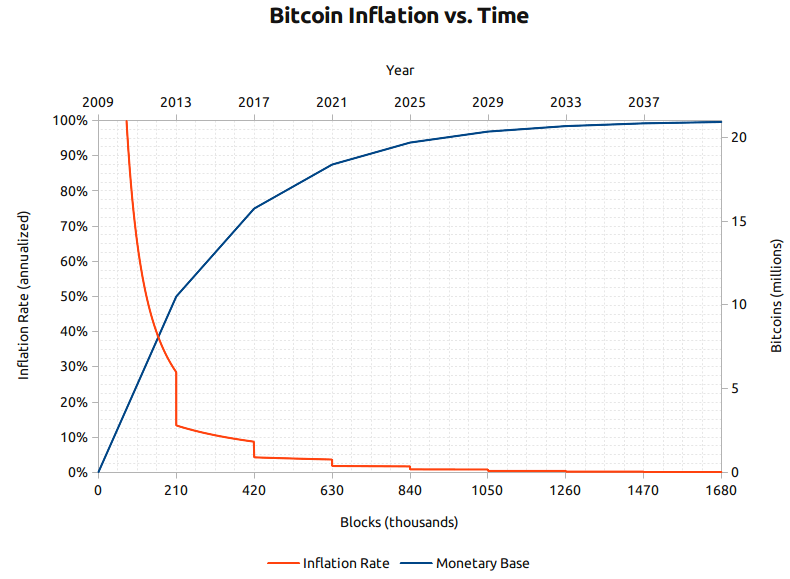
bitcoin monetary base

bitcoin monetary base

Let us think of Satoshium similar to gold or silver, with a few notable exceptions. Satoshium is rarer than gold; with only 2,100 trillion units (0.00000001 BTC–the smallest bitcoin unit, ‘a satoshi’) of Satoshium that can ever exist. Today there are about 1,350 trillion units of Satoshium that have been discovered through the ‘Satoshium mining’ process. More and more people are mining everyday with better, and better mining equipment–which is making it harder for current miners to find the mining reward. We will comeback to how bitcoins are ‘minted’ from satoshium using the coinbase reward process later in this post.

Another unique trait about satoshium is that it has a very, very steady inflation rate. For every 10 minutes of satoshium mining that is done on the bitcoin network (combining all of the mining power that everyone is using to find satoshium–be it 9 computers, or 9 billion) there are 5 billion units of satoshium discovered. After the first 4 years of mining, this amount was reduced by 1/2, to 2.5 billion units for the same 10 minute block of total work by the network. This amount will continue to divide in half every 4 years until there are no more units to be divided, which will be somewhere around 2138. Today there is much less satoshium available for mining than there was even just a few years ago–this is similar to the real deflation that metals, like gold, silver, and platinum experience over time, as they also have a finite supply.

Satoshium mining has become very difficult because so much mining energy is competing for these limited number of bitcoin units; the little guy can no longer mine satoshium on their own–it is simply too hard. This would be like trying to mine for gold with only a pick and shovel, while the guy next to you has a gold mining operation–you are not going to win. To resolve this, people discovered that if they ‘pool’ their work, everyone can share in the reward of satoshium mining based upon how much work they are doing for the bitcoin network.

The Minting of Bit-coins

Satoshium is really the coinbase reward, which is the raw material that bitcoins are minted from (fun fact, the only way you can truly destroy a bitcoin is through not claiming the full coinbase reward). In the same manner that gold is just a hunk of metal before it is minted into a coin; so is satoshium is to bitcoin. When someone is rewarded for satoshium mining, those satoshium units are grouped into chunks of 100 million units and ‘minted’ single bitcoin. This is the coinbase reward process. This ‘mints’ satoshium units into bitcoins based upon what the block reward is at that time, and pays that reward of new coins out to a new bitcoin address. This is the ‘minting’ process and how the bitcoin network creates new bitcoins.

Though each bitcoin is created equally, the data that comprises of each individual bitcoin is unique and different. Each bitcoin addresses has unique identifying properties, that differentiate each individual bitcoin to their owners, but to no one else. This is similar to the serial number that is unique to each dollar bill. This means that the history of that particular bitcoin (or subdivisions of that bitcoin) can be tracked, and can only be spent when the 53-digit unique hexadecimal private key authorizes its movement. If properly secured, it is impossible to ‘hack’ a bitcoin address and take the money from that address; as only the private key will be able to move it. This is why there are several bitcoin addresses that have tens of millions of dollars in them, and not a single one has been hacked.

The mining process is also what ensures that there are no ‘double-spend’ attacks. In lay-terms, a double-spend attack is similar to check-kiting, where one spending the balance in checking account twice before the bank can check to make sure the funds are there. We won’t go into details about this right now, but just be aware that the mining process also acts as the gatekeepers to the transference of funds, and offers mathematical assurance that no coins can be stolen, or double-spent.

The Money Supply of Bitcoin

The reason for us fictionalizing the metal Satoshium is to make clear the distinction between fiat currency that are made from nothing, and commodity money which must derive their value from an object’s intrinsic worth–the value is found in the money itself, not vice-versa. A fiat currency is a scrips certificate of exchange issued from a central bank. The scrip itself (such as a $20 bill) is just worthless paper–there is no bonitas intrinseca about it. An infinite number of these scrips can be created, as their values are created and set by the dollar accounting system controlled by the Third Bank of the United States (also known as The Fed–a misleading term that I hate). Each one of these scrips can be redeemed for goods and services for the nominal value printed on it, because it is legal tender–one must accept fiat money in exchange for goods or services. If not, you will face the wrath of the law.

Historically, once could exchange the nominal value of these worthless papers for a precise measure of commodity money, such as gold or silver. However, fiat currency no longer has any sort of value backing them–since 1973 they have been free-floating. Governments are now free to print as much money as the like, which they are happily doing. This is because there has been a low level currency war going on since 2008, and it is starting to intensify. This means that while there still is a finite, natural supply of all physical objects; there now is twice as much money (in the case of the US) that can purchase those same objects.

This is how governments expand the money supply to create inflation. This bleeds the value of the hard-earned savings of common people, in order to further enrich the current ruling class. All people in all nations are now facing these political calamities that will make us all economic casualties.

Velocity of Money

Velocity of USD

When more units of a currency are injected into circulation, this causes for a total number of units within the system to increase. If the velocity of money were normal today, this would mean that the prices of everything would double over night–but it has not. This is because the velocity of money is at historic lows, at less than 1/2 of what it normally is. This is not a mistake, but a response to the QE of the FED.

Let us compare this to how bitcoins are ‘minted’. Bitcoins derive their value from the bonitas intrinseca, the real economic work that has been preformed in the Satoshium mining process, and the use-value that Satoshium has. Each and ever single bitcoin in existence must have came from a coinbase reward–there is no other way to create bitcoins. In order to create the coinbase reward, real computational work that takes real energy–no different from the energy used to dig gold from the ground–must be preformed.

With Satoshium mining, this ‘work’ is done in the form of solving very, very, very complex mathematic problems that secure the network from ever being corrupted. This gives each bitcoin unit equal, market-based value due to the fact that it cost real-time energy to produce bitcoin today. There is no way to modify the number of bitcoin units that can be created (unlike fiat money), as bitcoins can only come from the coinbase reward, and that is hardcoded into bitcoin. This ensures all bitcoiners that no one can ever just change the supply of bitcoin in the way the US can, or any other central bank can for their currency (I’m looking at you Japan and EU).

Bitcoin as a Currency

Money can be held here and proven that it exist

This is a public bitcoin address. If you have the private key for this address you can control the money there.

For us to understand bitcoin as a currency, let us think of bitcoin paper wallet for the moment. This is a piece of paper that has the private key of a bitcoin address printed on it. When one inputs the private key of that address into a bitcoin client, they can access, and transfer the bitcoin found in that addresses. This is a currency bill in the most fundamental sense of the word; as it is not that piece of paper that has any value, but what it represents. What has value is the private key, as that can access the bitcoin–not the paper itself. The paper has only exchange value, not use-value. This is how banking classically existed for centuries with banking bills representing some value of gold until the 1973, when the dollar dropped its peg to gold.

Although bitcoin is called a digital currency, that is a bit of a misnomer. Bitcoin is not a currency but a commodity-money. Bitcoins must come from the coinbase reward process, and that process can only be done through the electrical labor of mining. Thus, like physical coins, a bitcoin can only be created when the correct ‘bits’ are ‘minted’ into bitcoins. Bitcoins cannot just be created willy-nilly–real computational work must be done, and real energy expended to mint bitcoins.

This is why we have differentiated the creation of bitcoin units from that of Satoshium mining. If we are to mint coins, physical or otherwise, we must have something to mint, we cannot make coins from nothing! And this is the very place that commodity monies are different from fiat money–fiat money does not represent anything other than the law, whereas bitcoins ARE something–very special data sets verified by the bitcoin network.

Bitcoin is a Commodity Money

gold-silver-bitcoinBitcoin is a commodity money because the cryptography that bitcoin is built on top of. This has created the contract that limits the supply of bitcoin units and protects the bitcoin payment network. It is cryptography that creates the immutable and fungibility of bitcoin units and the imperium of the bitcoin network. This immutability creates a use-value for bitcoin, which also creates its exchange value. Furthermore, the ‘satoshium’ units of bitcoin can be broken down and used for all sort of other various contractual functions. By understanding bitcoin as a commodity money, we can see the true value that bitcoin has is outside of the legal constructs of the state.

The internet now has money that is loyal to no political body, or statist organizations; but to digital ideals alone. This is not just the economic base of a new epoch, but a political one as well. Bitcoin is the economic praxis that will allow for humans to create a new class consciousness. We can use the internet to help us create a new society, and we can use bitcoin as the economic mode to create that new world.

Bitcoin is not about money, and has nothing to do with money. Bitcoin is about political power, sovereignty, and the freedom of economic exchange. This is in direct and antagonistic relations to any and all states. Bitcoin seeks to destroy the old institutions of political power, and replace them with new digitized, decentralized ones.

Once people start to see and reject the corrupt and worthless scrips of the states, there is going to be a great unraveling unlike anything we have seen before. The crisis will collapse the value of all fiat money to becoming nearly worthless, and the value of cryptocurrencies will explode. There will be chaos, and there will be anarchy–but these are the conditions of creative destruction that we must have in order to rebuild something better in place of this corrupt and wicked system called state capitalism. 

Next: Bitcoin and The History of Money

The Legal Politics of Money

Digital currencies are a new form of economic organization that exist entirely outside of the reach of the State. This has far-reaching ramification not just for money and capitalism, but for the ideological super-structure of the world today. Forcing concepts like exchange and economics into a theorem where tangibility is no longer needed causes for an unraveling of the state power structure itself. Institutionalized violence is no longer prerequisite for the monetary and legal system to function.

The ideological structure of capitalism has embedded itself into the state via the legal system. The State then acts as a thug on behalf of capitalist by enforcing laws through means of legalized repression and violence. It is from this proof-of-violence concept that states are able to force people to accept the legitimacy of contracts, the law, and the value of fiat money at the point of a knife. If governments could not the violence of their legal systems to enforce the acceptance of fiat money, or the repayment of debt; the entire international monetary system would collapse overnight.

Sovereignty of Value and Legal Ideology

All contemporary forms of fiat money rely on the physical and legal enforcement of laws, and the monopolization of the payment systems in order to create exchange value. All state money systems operate on maxims of restrictions based in law, enforced with mystical propaganda in one hand, and a clenched fist of enforcement in the other. The propaganda that is used to convince people of the need for the State to control money is far more important than the laws that create that money, or the guns and violence that are used to enforce their value. It is only through the repressive apparatuses of the State, and the cooperation of their capitalist allies that allows for this system of fiat money to continue to hold value.

Legal restrictions create the nominal values of the currency bills from all states. It is the same for the EU’s Euro, the Chinese Yuan, or Malaysian Ringgit–the currencies have nominal, redeemable value for goods and services in those Nation-States (or unions), and not outside them.

The value of these national currencies are created explicitly from the monopolization of the payment systems, and the monopolization of the issuance of legal tender. The monopoly of money itself via legal tender, and the monopolization of the payment system by the banks working with the state, is how national currencies forces themselves into a means of value, unlike commodity-monies like gold, sliver, or bitcoin.

The value of fiat money is unnatural and is only create through legal force. The power to create fiat money exist solely in the legal realm. However, what forces them to have value is the violence in which the laws based around those nominal values function. There is no such law to make commodities into money; they are simply valued.  Mises surmises this in the appendix of “The Theory of Money and Credit,”

Ludwig von Mises

Ludwig von Mises

“Another acatallactic doctrine seeks to explain the value of money by the command of the state. According to this theory the value of money rests on the authority of the highest civil power, not on the estimation of commerce. The law commands, the subject obeys. This doctrine can in no way be fitted into a theory of exchange; for apparently it would have a meaning only if the state fixed the actual level of the money prices of all economic goods and services as by means of general price regulation. Since this cannot be asserted to be the case, the state theory of money is obliged to limit itself to the thesis that the state command establishes only the Geltung or validity of the money in nominal units, but not the validity of these nominal units in commerce. But this limitation amounts to abandonment of the attempt to explain the problem of money. By stressing the contrast between valor impositus and bonitas intrinseca, the canonists did indeed make it possible for scholastic sophistry to reconcile the Roman-canonist legal system with the facts of economic life. But at the same time they revealed the intrinsic futility of the doctrine of valor impositus; they demonstrated the impossibility of explaining the processes of the market with its assistance.”

This difference between valor impositus and bonitas intrinseca: the nominal value of units imposed by the state–such as the dollar or shekel–and that which holds real intrinsic value; such as the metals, minerals, or other storage of value.

The best example of how these two values act against one another would be a gold coin that has a lower face value than what the coin is worth on the open market–it is not the stamping of the metal that creates value, but the amount of gold that it is comprised of.

Mises spoke further of the historical difference between the nominal value of coins, and their weight as metal:

“Nevertheless, in defiance of all official regulations and prohibitions and fixing of prices and threats of punishment, commercial practice has always insisted that what has to be considered in valuing coins is not their face value but their value as metal. The value of a coin has always been determined, not by the image and superscription it bears nor by the proclamation of the mint and market authorities, but by its metal content. Not every kind of money has been accepted at sight, but only those kinds with a good reputation for weight and fineness. In loan contracts, repayment in specific kinds of money has been stipulated for, and in the case of a change in the coinage, fulfillment in terms of metal required. In spite of all fiscal influences, the opinion gradually gained general acceptance, even among the jurists, that it was the metal value—the bonitas intrinseca as they called it—that was to be considered when repaying money debts.” Part 1, Chapter 3

Today because of the structure of late capitalism, where the state monopolizes the currency, and the banks monopolize the exchange of currency, there is no way to demand repayment in anything other than more fiat. It is from the insidious brilliance of forcing all exchanges into legal structures with no alternative payment forms, that fiat money both creates its own value, and also becomes a legal power.

We can see that money today is not valued because of its bonitas intrinseca, but only its valor impositus. This means that the only way that the state can make its money hold value is through explicit legal means, which are reliant on repressive legal enforcement, and nothing else.  

Physical World Against Digital Laws

There is a glaring issue with this mode of money creation when we start to consider for a moment that the world that we live no longer is orchestrated by legal enforcement of the state, but digital communications.

There is no physical footing in this world, no place for the apparatus to establish itself.The repressive violence states use to enforce their laws simply cannot exist here.

If we return to Foucault in Truth and Power he provides us with more hints about the functions of the state and why ‘cutting off the king’s head’ has been impossible until recently:

Moderator: The King’s head still hasn’t been cut off, yet already people are trying to replace it by discipline, that vast system instituted’-in the seventeenth century comprising the functions of surveillance, normalization and control and, a little later, those of punishment, correction, education and so on. One wonders where this system comes from, why it emerges and what its use is. And today there is rather a tendency to attribute a subject to it, a great, molar, totalitarian subject, namely the modern State, constituted in the sixteenth and seventeenth centuries and bringing with it (according to the classical theories) the professional army, the police and the administrative bureaucracy.

Foucault: To pose the problem in terms of the State means to continue posing it in terms of sovereign and sovereignty, that is to say in terms of law. If one describes all these phenomena of power as dependent on the State apparatus, this means grasping them as essentially repressive: the Army as a power of death, police and justice as punitive instances, etc. I don’t want to say that the State isn’t important; what I want to say is that relations of power, and hence the analysis that must be made of them, necessarily extend beyond the limits of the State. In two senses: first of all because the State, for all the omnipotence of its apparatuses, is far from being able to occupy the whole field of actual power relations, and further because the State can only operate on the basis of other, already existing power relations. The State is superstructural in relation to a whole series of power networks, that invest the body, sexuality, the family, kinship, knowledge, technology and so forth. True, these networks stand in a conditioning-conditioned relationship to a kind of ‘meta-power’ which is structured essentially round a certain number of great prohibition functions; but this meta-power with its prohibitions can only take hold and secure its footing where it is rooted in a whole series of multiple and indefinite power relations that supply the necessary basis for the great negative forms of power. That, is just what I was trying to make apparent in my book [“The Order of Things” which was originally titled “Words and Things.”].

To cut off the king’s head we must venture into a realm where a footing for his power cannot be found. A realm where the physical violence, repression, and thus the capacity to physical enforce nationalistic laws cannot exist. The meta-power of the state and their various laws end where they do–in physical territory, in a physical world. There is no need to cut the heads off of false prophets whom we are immune to.

Digital sovereignty departs from the theology of law, and builds a new economic system that operates from a critical bias of math, instead of physical enforcement. These systems are based upon non-physical knowledge alone (knowledge of the private key), which means these systems are built solely around their mathematical soundness. The code upon which these currencies are written is their own sovereign valor impositus. The computer code itself is the legal-mathematical structure that enforces the rules of bitcoin, and other digital currencies–no State or third-party is needed.

Digital Sovereign and The Banishment of Physical Force

Digital currencies are the kernel of power that a new economic and legal superstructure will be built from. Power is no longer something that comes from the sword, but from the pen.

Violence cannot be an explicit tool of enforcement or appropriation in a nearly-anonymous, digital system like bitcoin or other digital currencies. Economic independence outside of the control of the state or the banks is now a real possibility. This severely underminds the power of the State, the banks, and state-capitalism in total. Digital currencies allow for a new frontier of economic freedom and independence, that is not achievable with the current monetary and legal systems. With bitcoin, people are free to choose who they conduct transactions with, without the permission of the state, banks, or the violence they use to enforce their laws.

When we start to critically assess the current money systems of the world, along with the ideological and mythical structures of sovereignty, law, and the state; we find that they quickly break down under scrutiny. We come to understand that the dominion of the ideologies over our lives is not based upon some holy, progressive knowledge that protects us and gives us salvation; rather, it is barbarism wrapped in blanket, upon blanket of lies, obfuscations, and deceptions.

We see that it is not magnanimity or justice that governs the actors of the State; but selfishness, greed, corruption, and cowardice. We come to see the world as Angelus Novus did, and the horrors of what is stacked in front of us and growing with each passing day. To make whole that which has been smashed is possible, but we must wake the dead in our quest for redemption. The gate is strait, and it is our duty to show others the liberation that can come with each passing second.

In the declaration of independence of cyberspace we declared our virtual selves immune to state sovereignty, even as we continue to consent to the subjugation of our bodies. In the mean while we have spread to every corner of the global to ensure that our thoughts cannot be arrested, and so that the crimes of the state and capitalism will be seen by all, for all of history to come.

We now have the means to reappropriate our sovereignty, our economic independence, and ultimately our political organizations and the State itself. This can and will be done to end the era of state-capitalism, and usher in a new era of global digital organization. We are creating a civilization of the Mind in Cyberspace, and using digital currencies to economically unite us is the first step towards this new world.

Next: Bitcoin as a Commodity Money

Sovereign Violence and Legitimacy of Law

“Yes, [we will not find a solution to political problems in cryptography,] but we can win a major battle in the arms race and gain a new territory of freedom for several years. Governments are good at cutting off the heads of a centrally controlled networks like Napster, but pure P2P networks like Gnutella and Tor seem to be holding their own.”

–Satoshi Nakamoto

This is one of the few political comments that we are offered from Satoshi. This is a reference to Micheal Foucault’s interview on power and sovereignty found in Truth and Power:

The monarchy presented itself as a referee, a power capable of putting an end to war, violence and pillage and saying no to these struggles and private feuds. It made itself acceptable by allocating itself a juridical and negative function, albeit one whose limits it naturally began at once to overstep. Sovereign, law and prohibition formed a system of representation of power which was extended during the subsequent era by the theories of right: political theory has never ceased to be obsessed with the person of the sovereign. Such theories still continue today to busy themselves with the problem of sovereignty. What we need, however, is a political philosophy that isn’t erected around the problem of sovereignty, nor therefore around the problems of law and prohibition. We need to cut off the King’s head: in political theory that has still to be done.
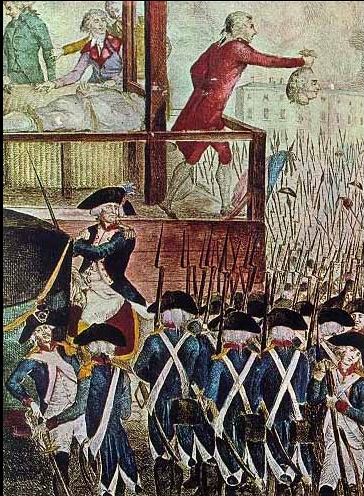
Sovereignty, Legitimacy and How Violence Connects Them

The fundamental issue at hand is one of sovereignty–who has the supreme right of rule? Today, governments around the globe have anointed themselves with the supreme right to rule over almost every aspect of life. This is not because of their majesty or our consanguinity, but simply from their monopolization on violence, and the legal framework they use to justify it. There has been a long, and precipitous train of abuses that has created the world as it is today, and considerable injustice that has forced us to ask such questions.

We first must questions where this Right comes from. This Right is not only a historical residue impressed upon us from the evolution of society from feudalism, but also an ideological perspective that is reinforced incessantly throughout our lives. When we reduce this power down to how it operates on an individual and organizational levels, we can see beyond the garb of officialdom, legitimacy, and righteousness that it purports to be, for the crude, barbaric machine that it really is: violence organized under the banner of the state.

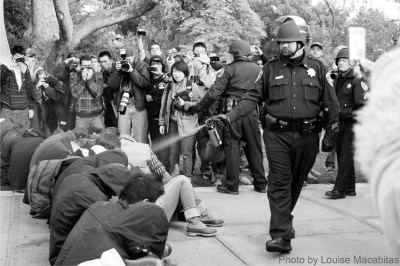
This action was legal for the police to carry out–no violence came to the officer for doing this.

Violence is the basis of power that governments use to project their legitimacy into the world. This is done through explicit means, such as police, military, prisons, laws, and regulations; but also through discreet means such as education, religion, bureaucracy, and especially elections. The discreet channels of what is seen as ‘correct’ or ‘legitimate’ is the most powerful form of controlling the conversations of ‘what is violence’ and who is entitled to it. This creates the context for which violence can be used, and thus justified. The utilization of violence to enforce the status quo (i.e. the law) is justified by the ideological discipline that demands authority to be respected, and obeyed for no reason other than that ‘authority should be respected, and obeyed’.

The fact that we are allowed to vote for one of two representatives that invariably represent the same corporate interest of the status quo, is part of the greater dialog that has us believe the legitimacy of such violence. We are told that we have ‘democratic power’ and that if we can just elect the right person (despite having no sort of electoral process for the police or army), that we will be able to solve our political woes. The truth of the matter is distinctly different.

There are people in this world that can initiate violence against others within explicit legal means with no form of recourse. We are subjects underneath the law and subject to it, and we have masters that are outside and above the law; which ironically calls itself the ‘law enforcement’.

It is the threat of this systematized violence in all capacities (legal, economic, personal) that governments base their power from. It is under this banner of legitimacy via legal violence that all governments have operated through all of history. That might shall make right, and as the official judicial decision, that is final. This is the legal bases of the laws of the state, and this is why they can command your death–because they have the power to do so.

Sadly, there simply has never been any other way to politically organize with the exception of sporadic, unsustainable revolutions that fold back into the same power structure that rely on violence. As revolutionary chaos grows, it harnesses the apparatuses of power for itself, and becomes the Specter of the State, legitimizing its own violence and corruption.

This is the theory of the sovereign–how political institutions create power over one another–it is done from the point of a sword, again, and again; through all of history.

This is the revolutionary struggle for sovereignty. As Foucault pointed out, so long as we are still grappling with this central issue in political theology of enshrining the power of life and violence one over another into a legal system, be it in the form of a senator, minister, police officer, judge or king; there will still be the problem of the great negative forms of power. Masters of all institutions seek to be good masters; but first and foremost, they seek to be masters. There is an alliance among the aristocrats that they all believe there is good reason for them to be masters over the world, and to hold power over all.

Sovereignty as we know it can only exist at the bequeathment from something or someone; or violently take from those same powers through revolution. Once entered into the subject of sovereignty, there is an immediate glaring flaw that a political body must offer sovereignty, or it must be taken by force. This force is what we seek to avoid in the first place, and what has locked humanity into a permanent struggle for power against and over itself–homos lupus homnium. For all of human history, this concept has battled between its two poles: one of accepting the sovereignty offered from another, or to fight that offering to take it for oneself. Violence and physical force are the tools used for the sovereign struggle to establish who is master, and who is slave.

Political History of Sovereignty

The most recent political revolutions of the late 16th century shifted the power by delegitimizing the divine right of kings, and enumerating that power into republican councils. Although there was resemblances of change within the structure of power, what really occurred was a shattering; a mutation of the system and a fracturing of power among many actors.  Sovereignty was stripped from kings, and that power was divided among the various ideological structures and repressive state apparatuses that make the modern state.

Screen Shot 2015-05-30 at 9.08.16 PMPower is no longer centralized within one body (The King), but is fractured into the government bureaucracy itself as a corporate body. Power, legality, legitimacy, sovereignty, the party as aristocracy, and state-sanctioned violence as a means to execute the law, are all part of this same political-government structure. However, these forces are no longer vested in the one body of the monarchy, but a new body of people outside the law itself. The decree of Divine Right that was once used to inflict the rule by Kings, is today being used to inflict the Rule of the State, but this time under the title of civil liberties.

Invariable, man finds himself under the bludgeon, chain, and whip, happy to oblige, for he no longer has one master, but many! And this time they are for the good of civil liberties! He fails to recognize that the defenders of civil liberties seek to protect their own rights first and foremost at the expense of his flesh.

Violence is the means that compliance with unjust laws are explicitly extorted upon the populous.  It is not the justice or majesty of contemporary legal systems that enforces the law; but ruthless, uncaring, violence. It is within the hidden manipulations of what is normal and appropriate that we also find apologists who demand to be ruled as a subjects, not people.

If people are to liberate themselves from such an insidious and total system of rule, it must be upon their own merits to help themselves. People must arm themselves with knowledge, and a willingness to think critically to create a new, and better world. Using the internet, bitcoin, and strong crypto we can create a better world, and establish new laws from within the internet to help save us from global environmental catastrophe that is coming.

Cryptography and Self-Legitimacy

Digital currencies retreats from the theology of sovereignty via violence through creating a new mode of sovereignty. Intangible and non-physical, this new form of power is created through a destituent form of power, one that withdraws and refuses to cooperate with any form of violence.

Legitimacy within cryptography is created from knowable and provably unbreakable secrets that can only exist the digital realm or mathematics. It cares not for what occurs in the physical world, but only that of which it can experience in the digital world: provable mathematics and the sacrament of the private key.

Legitimacy no longer comes from an authority within the current political or economic system, but creates its legitimacy through explicitly existing outside of any states control and the violence they enshrine. 

The concept of sovereign is flipped on its head. No longer does legitimacy need to come from state institutions that are empowered via violence, but through provable mathematical systems that are not part of the violence power structure. This creates a new economy system with No God, and No Masters.

No longer do we need to pay for the privilege of our freedom to exchange with one another, or be extorted by the Gods of Government, or their Masters of Capitalism.  Bitcoin re-invents money into what it once was, and was always suppose to be–a network of legal and economic exchange for all people everywhere.

Next: The Legal Politics of Money

The Absolute Value of Crypto

Secrets have a value. How much, it is hard to say, perhaps invaluable would be a more apt description. Invaluable because a secret can mean the difference between life and death; that which can lead to victory or defeat in war. Secrets have an absolute economic value as well because it can truly mean the difference between life and death. Cryptography understands that the security of communication is essentially to life and death, and there is real value to both privacy and secrecy.

Bitcoin and other digital currencies are built on top of strong cryptography for this reason. This cryptography is strong enough to be considered unbreakable at this point in time, and most likely for the next several decades. Due to the mathematically assured, provable secrecy that bitcoin is built on top of, bitcoin creates additional value outside of the energy spent mining bitcoins by creating a cryptographically strong system of digital exchange. The ability to exchange through strong cryptography, and the secrecy it affords is part of what creates the economic value of bitcoin.

This value comes from the commodity that bitcoin is made from. Just as gold’s secondary values comes from its fungibility; the proof-of-secrecy function of bitcoin gives each unit their fungibility, which in turn creates secondary value. The provable mathematical security of bitcoin means the system is totally secure from legalized theft. No state, banker, or military general can steal your securely stored bitcoin; no matter how powerful they may be, or how many guns they have pointed at you.

A Very Short History of Crypto and War

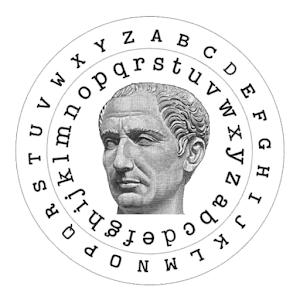
Cesar’s Shift Cipher

Even before Julius Cesar first used his simple shift cipher for encoding his messages; ciphers, and stenography were wide used to conceal information throughout ancient history. These tactics of hiding information and keeping that information secret, or Crypto, developed as a tactic for war, and has had a large role within power struggles throughout the centuries.

As Napolian Bonaparte said, “The secret to war lies in communication.”

Over several millenia the developments of stenography and shift ciphers got better and better, as they were used for diplomatic and military purposes. A major advancement in the field occurred when poly-alphabetic ciphers, such as Vigenère cipher in 1553. Several centuries later the developments of cryptography were culminated in Kerchoff’s “La Cryptographie Militaire” in 1883, which are now surmised in Kerchoff’s principals.  This was a scientific manifesto on the military application of cryptography, and how to understand the security of cryptosystems and breaking them. Of these principals that Kerchoff established was the need to make the system based upon mathematical principals, and the supremacy of keeping the secret key secret, as if you do not, the system will be know by your adversary.

Just as in war you have an enemy, in crypto there is an adversary–an opponent that is seeking to compromise your system, and break it of its secrecy. If your secrecy is compromised, and if the secrecy of this communication is based upon life and death, you will die. This value of secrecy is absolute, and nation-state’s wars against one another accelerated the improvement of cryptography at a startling rate. This arms race in crypto ran parallel to the arms race for nuclear weapons in the 20th century, and was just as pivotal to its outcome.

The Mechanization of Cryptography for Advanced Warfare

Enigma Machine

The mechanization of ciphers with the rotor machines were developed in the early 20th century. It was the first true attempt to apply a more robust computational principals to ciphering with machines. The mechanization of ciphering reached its apex during WWII with the German enigma machine. In order for the Allies to break the encryption of the enigma, they had Alan Turing develop The Bombe. This was one of the first computers ever created in order to crack the code of the German enigma machines. These ciphers had become so complex, they now needed computers to help with the complex mathematical calculations to crack their code.

Like the wars that the empires throughout the ages have fought; at first their tools were rudimentary and crude, but developed with sophistication, technology, and scientific precision over the ages to what they are today. States now command weapons of mass destruction that can wipe out millions of people in a moment, and they use this as a token of power within the realpolitik of statecraft against other states.

This is called brinkmanship–the art of pushing dangerous scenarios for favorable outcomes on ones own terms. It is within this same vein of power that the tools of cryptography were developed as a means of war. We must ask ourselves: why has this technology been so zealously guarded, with so much human energy expended upon it?

Privacy and Secrets as Power

It is because within the realm of secrecy and privacy that people can organize independently, and outsmart stronger, more powerful enemies. Encryption is a weapon for the weak against the powerful, and a way for individuals to be given a mathematical assurance against the invasions of privacy, both for personal documents, and communications.  It is a mode of mathematically assured protection. One needs not to trust people with money or secrets any longer. Now they only need to trust the code upon which their secrets are hidden. That code is only mathematical, and is binary in nature.

From being built on top of this mathematical encryption technology that cryptocurrencies create a true use-value. Proof-of-secrecy creates both fungible, and security. These features, paired with the limited number of bitcoins, and computational and electrical energy that goes into creating bitcoin units, creates the total concept that gives bitcoin, and other digital currencies, their value. Bitcoin and other digital currencies give rise to a new mode of sovereign economic power. It is this economic force that over the coming decades will deconstruct, and depose of the old concepts of money, value, banking, exchange, protection, and finally the state itself.

The Digital Sovereign

Digital currencies are the economic power that will become the bases for a new way of organizing. This new form of power will create new social, economic, and political organizations which together will create a new superstructure of power I call the digital sovereign. Echoed in the sentiments of the declaration of independence of cyberspace, this is the process of creating a world that all may enter without privilege or prejudice accorded by race, economic power, military force, or station of birth. The digital sovereign is the space in which the civilization of the Mind will make itself victorious over the world of flesh and steel.

Next: Bitcoin and The Internet as Ideological Apparatuses

Bitcoin and The Internet as Ideological Apparatuses

Bitcoin is not about money–it’s about power. Bitcoin is a political force, technological ideal, and mode of economic independence for the internet itself. Using Louis Althusser’s concepts of ideology and ideological state apparatuses from, “On the Reproduction of Capitalism” we can analyze bitcoin and the internet as as anti-state ideological apparatus.

10f96-althusser160x220tHere is an excellent introduction to Althusser’s concepts and an explanation of what exactly is ideology, ideological apparatuses(IA), and repressive state apparatuses (RSA) are.  In his work, Althusser offers a powerful way of understanding the organizations of capitalism. He shows how various ideological apparatuses operate in conjunction with repressive state apparatuses to create, organize, reinforce, and reproduce the conditions of society today to serve the current capitalist paradigm through the state.

For our purposes we can apply this same logic to understand where the internet fits into the capitalist society. From this we will see how paired with the  power of bitcoin, and other digital currencies may develop.

The Internet as an Anti-State Ideological Apparatus

The Internet is a new territory, and today is controlled by States for the use of capitalism; but they are quickly loosing control. This occurred by design as the internet grew from the small U.S. government project it once was; and developed into the global world wide web it is today. Today they internet rivals G7 states in terms of its population, GDP, and most importantly its ideological norms.

Though there are many internet cultural groups today, the original ‘internet culture’ would be the cypherpunks. From the cypherpunks came publications like, “Security without Identification: Transaction Systems to Make Big Brother Obsolete” wrote in 1985.  Even before the world wide web existed, the anti-state principals of the digital movement were already entrenching themselves.

Those involved in the cypherpunk movement would later go on to write the declaration of independence of cyberspace, and would help advance the internet at every new crossroads it came to. This early vanguard of the internet operated on tenacious, uncompromising principals of freedom of information, communication, and the right to privacy. These ideas imbued themselves into the internet and became an ideological backbone that allows for the open web to function.

The Internet is antithetical to the State.In this realm people can create new identities that could not exist within the physical realm.We given the right to developed our voices and identities free from the constraints of the panoptic police state. Our physical bodies no longer constrain our ideals; we have moved beyond being mere sinew and flesh and into the Noosphere. Here exist a mode of communication where we are stripped of our human bodies and become only the political body of the words and information that we convey here. Our names, national identities, religions, educations, and every other form of inscription that we are subjugated within contemporary society are secondary within the internet.

The identities that we are allowed to created for ourselves on the internet, unmolested by the forceful ideology of the various state apparatuses and under the guise of anonymity; we become more than mere objects to be subjugated to the desires of a capitalist society. We are allowed an entire universe where we can choose who to become, and to seek out the information we desire to know. Everything that defines us as subjects, and the territory of physical space that we occupy becomes secondary. Our physical bodies cannot exist within this medium; nor is it definitive of who we are in this space–we are truly free here. These are the murmurs of the new class consciousness that is forming inside of the internet itself, and it cannot be stopped.

Althusser believed that the education was the most powerful ideological apparatus that there was. Education as an institution is a tool exclusively owned by the ruling classes explicitly to control the dialog of what is knowledge and what is education. The so-called fields of factual hard sciences focus their narrow pursuits in the name of capitalism, to the same degree that fields like history, economics, and political science seek to justify the capitalist world we live in. What is considered ‘education’ becomes part of a great dialog that is no longer about facts, critical think skills, and self-empowerment; but learning obedience as truth.

This has profound and far-reaching ramifications when we consider that scientific knowledge is the bases of power in a advance technological capitalist society such as ours. With unrestricted, unfettered access to information, along with the assurance of what one is search for and coming to understand is private; one is freed from the ideological chains of the system that controls every aspect of lives. Here it is possible to develop one’s own truth without the taint of capitalism– we can form truths of the world from our own standpoint without fear from of the panoptic police state watching us.

Education as Ideological Entrenchment of Capitalism

Do as I say, because as I say is correct

The internet stands in direct contrast to the educational establishment and its ideology. The education establishment is reliant on authoritarian knowledge official, state-sanctions communication channels (teachers, libraries, degree programs, etc.). Whereas the internet is antithetical to that. There are no minders or masters to deem what is appropriate ‘knowledge’–only facts that present themselves for what they are.

This implies that ‘education’–or the acquisition of knowledge via the internet–is something that must be done autodidactically. One must disseminate information for oneself, and to compare and contrast sources to discover the difference between what is ideology, and what is fact. This can only be done alone, and using one’s own faculties.

The Internet is an endless well of information for those who seek it. There are no minders or masters to approve of fact which establish themselves by the truth of their being, rather than the sanction from official sources. This destroys the ideological monopoly that education institutes have on the source for knowledge, which can call the paradigm of  classic education institutes, and their relationship with capitalism. The impact of this is not unlike the Protestant Reformation challenging what was the authoritative source for knowledge.

Through the domination and monopolization of ‘what is knowledge’ vis-a-vis educational institutions, there is a wicked contortion of knowledge. Knowledge is no longer fact, but idology. This is reinforced repeatedly incessantly to such an extent that one becomes confused between what they know to be true for themselves, and what one has simply been told so much, that one believe that to be true.

Money as an Ideological Apparatus

So how does this all relate to bitcoin and money? Money as a concept is deeply, deeply embedded into us as a ideology and religion. Due to the constant bombardment of misinformation about how money works, from all ideological state apparatuses (media, school, work, etc.); money becomes a very complex and convoluted topic. Due to all of these various influences, money ends up taking on its own mystical weight, and becomes a powerful ideological component of the current economy paradigm.

Through the education system we are taught that governments are good, and the world works the way it does for good reason. We learn from this system that economist can explain why the economy functions as it does, and why we all must work hard to take home our day’s pay. Included in this ideology is the notion that  our noble business leaders, who lift the world upon their shoulders, are entitled to a king’s share of the wealth for directing his firm to make a profit; even if this is at the expense of many.

This ideology serves to alienate and divorce economics from its original purpose as part of philosophy. Today almost all economist are exclusively modern monetary theorist who are heavily relent upon complex mathematical modules to explain economics. Any economist who does not accept the concept of seigniorage as fact, are simply disposed of as not being ‘real’ economist. From the get-go, we are taught to believe in the righteousness the economic system and to not question it on a fundamental level.

This is how government are able to control the money supply and keep huge portions of the globe under the despotism of poverty without anyone blinking. We have been taught to believe that capitalism in its current form, backed by the state, is the only way to organize the economically and politically. We have been told that money functions perfectly being controlled by bankers and the state, despite all factual evidence against it.

Bitcoin as an Anti-State Liberative Apparatus

Due to the influence of the internet, and the way that people use it to discover information for themselves; there is an autonomous space for an non-state money to exist. Bitcoin is the antithesis of both repressive state apparatuses and ideological apparatuses.

The main purpose of bitcoin is to act as the central bank of the internet. Like the Internet, bitcoin is distributed, decentralized, and ran by a protocol which allows for communication anywhere in the world. Its first and primary economic loyalty is to the internet itself–no internet, no bitcoin. Its secondary function is one that represents the ideology of the internet itself.

Digital currencies are revolutionary because they were built with revolutionary ideology at their core. Bitcoin is money built for the internet, and the internet alone. There were plenty of other digital monies that came before bitcoin, they died because they did not have the capacity to stand against the state. Bitcoin was built on top of strong crypto because Satoshi knew that if any money for the internet were to truly gain traction, it would become the implicit enemy of any and all states.

What I find the most fascinating about this ideological function of bitcoin, is that it uses the logical exploit of capitalism, and how capitalism holds the sanctity of itself (capital) above all else (or as Marx put it, the valorization of value) to turn capitalism against the state. Through removing money from the hands of the repressive state apparatus of banking, bitcoin makes money more effective than it has ever been.

Bitcoin can do this not because of the powerful ideological argument it offers, but because of its economic efficiency over other moneys. Bitcoin and other digital currenices have the capacity to take on all of the economic roles that the states, and can do it for a fraction of the cost.

As we catapult into this brave new world, we will find that other ideological apparatuses will slowly change their perspective about bitcoin. This will not be because there will be some radical awakening to understand money; but rather the reproductive purposes of capitalism will fulfill the role that Althusser predicted it would. The capitalist paradigm will shift from that of being in alliance with the state, to being in conflict with the state. And this will be because the state itself will become inefficient to the service of capitalism via the internet, and thus can be disposed of like everything else that does not serve capitalism.

As bitcoin gains more economic power, it will also gain political, and ideological power. It will utilize this base of power to pull back the veil of corruption and expose the powers that be for the banality that they are. Another world is being build where the State is not allowed, nor any of the ideological apparatuses that serve it.

Next: The Magic of Money, The Science of Bitcoin

The Magic of Money, The Science of Bitcoin

The greatest barrier to bitcoin adoption today is the mysticism and magic that surrounds money and wealth. Due to this mystical perspective of money, many people do not understand the scientific functions of money as an economic mode of exchange. However, when we can come to understand bitcoin and money from a scientific perspective, we can pull back the curtain of Oz and see the little man for what he is.

The Mysticism of Money

I use the words magic and mysticism very specifically. When I say mysticism, I am not talking about true fairy-tale like mystical forces, but the human perception of the legitimacy of the unknown.  The unsaid agreements that run and dictate larger forces within our society that one does not understand, but one accepts at face value. It is here that we find the sacrifice of knowledge-sovereignty  in exchange for mystical comfort–there is strength to be found in ignorance.

Magic is the application of psychological obfuscation to obscure what the truth is. The application of ‘magic’ creates a mystical story around whatever the target does not understand. This creates the false reflection of truth through offering ‘what is’ as a justification for how it should be. This article in Time Magazine’s blog speaking about the dangers of bitcoin is an example of this.

This article speak of how the most recent report from the consumer financial protection bureau warns that bitcoin is, “Vulnerability to hackers, limited security, excessive costs and scams…Virtual currencies are not backed by any government or central bank, and at this point consumers are stepping into the Wild West when they engage in the market.” However, what Time fails to understand that this is the whole point of bitcoin.

Bitcoin seeks to ensure that West stays wild. It seeks to take money completely out of the hands of governments and regulators due to the fact they cannot be trusted with the economic prosperity of all. This propaganda piece from Time made to scare people into continuing to trust their governments with their money and economic prosperity, despite the mountain of evidence that we should not.

However it is not enough alone to simply use propaganda and lies to create a mysticism–violence, control, and intimidation must also be an implicit facts of how ‘The Story’ is forged. This is part of what creates the ideological paradigm that money must be control by governments, or terrible thing will happen! This story is perpetuated by making money into something that only ‘experts’ can understand, as it is just too complicated, risky, and difficult for the common man to understand.

The Science of Bitcoin

Bitcoin is a financial system that is based upon scientific logic. This logic is derived from the mathematical bases and protocol upon which bitcoin is built. Those who use bitcoin understand that the known, limited supply of bitcoin, is part of what creates the value of bitcoin in the first place. Bitcoiners don’t want backdoors built into the protocol, or allow for the suits in banking or government to have any kind of access to their money–that’s the whole point of bitcoin! There is substantial evidence that these bankers and regulators want to be good masters, but they seek to be our masters. There is ample evidence of the long train of abuses that clearly shows what they want to do with that power, and it is not to protect the average citizen.

The myth of money is animated behind the belief that the ruling establishment is pushing that people cannot, and should not have control of their own money. There is not a strong analytically case for this, but half-truths, fear-mongering, and an obscuring of what is true to attempt to herd people away from trying to achieve true economic independence for oneself. Whereas bitcoin and other digital currencies make the argument for why their are powerful modes of exchange and storage of wealth through strong, scientific whitepapers. The virtue of the value of digital currencies come from what they are, and what they are alone–not from the authoritarian systems that ask us to trust them without any reassurances.

The science of bitcoin comes from its mathematical bases, and that anyone can review the code that build it. Bitcoin creates an argument for itself; you can see and understand how it is ‘unhackable’ when stored and used correctly, and see how the cryptography behind bitcoin keeps everything private. You can see how much the fees are for using bitcoin with the knowledge that there no other sort of hidden fees, random fund seizures, or someone who will deny you access to your own money when you need it. Digital currencies can be used anywhere on the planet (and in space as well), and can cross boarders with no hassles or declaration forms to be filled out. Bitcoin is simply better money than fiat simply by what it is.

To Pull Back the Curtain

The con is up. The once ever-so-powerful wizardry that created and legitimized the banking, financial, and money systems can now be seen for the trickery that it is. The internet has given us the access to the information that lets us to tear down the curtain and see the wizard for who he is. As the false prophet flails and panics to put the curtain of obstruction and mysticism back up, we will find that his tale no longer holds the power it once did. We those behind the curtain for the criminal they are, and the way that they do it; now it is just a matter of time before people see these powerful institutions for the criminals that they are as well.

Next: Antifragile Bitcoin

Gresham’s Law and Bitcoin

Over the last few years there have been a number of papers and blog post on Gresham’s law and bitcoin. Most of these have rudely proclaimed that bitcoin will die because of Gresham’s law–ironically, it will be fiat currencies that will die because of that law, not bitcoin. This is because the real value of fiat money is always going to be lower than the real utility value of bitcoin. As the illusion of fiat money is exposed for what it is, the value of bitcoin compared to it will continue to go higher, and higher.

Gresham’s Law, Real and Nominal Values

Gresham’s law dictates that bad money will drive out the good due. This is due to the fact that ‘bad money’ is overvalued so you want to use it; while good money is undervalued, so you want to save it. Thus, consumers will get more bang for the buck using the inferior money, and will benefit from hoarding the superior money.

Let me elaborate in an example using a $100 bill and a 1oz Gold Double Eagle $20 coin. In terms of the recognition of value, the $100 has a higher nominal value than the $20 coin. However, one would be an idiot to spend the $20 gold coin on $20 worth of goods, as the gold coin’s commodity value worth well over $1000. This is why we don’t see $20 gold coins floating around–people have ‘horde’ them up so those coins are no longer in the money supply.

This is what is meant by the saying of Gresham’s law: bad money drives out the good. Please see difference my post The Legal Politics of Money for more details on the difference between nominal value (valor impositus) and real commodity value (bonitas intrinseca).

In contemporary society, we have a hard time understanding that ‘money’ is really just a catch-all term for ‘object of exchange value.’ Really anything can be money–gold, bushel of wheat, salt, seashells, etc.–what is important about money is that it is an equal and standard measure. Because governments have historically fix fiat money’s value to something (in the case of the 1oz gold coin, it was $20, as that was the rate that the FED honored from 1913 to 1933–1oz of gold was = $20) it creates two values: real and nominal.

This means ALL money has two values–a real commodity value, and a nominal value. The commodity value is the worth of the object that the money is made of; such as the gold the coin is made from, or the paper that a dollar bill is printed on, or the electrical energy that is spent on mining bitcoins. This commodity value will always be independent of the nominal money value of money.

Historically, governments always ‘pegged’ the nominal value of government money to the commodity value of gold or silver. Today however, because dollars are not pegged to anything and are free-floating, the value of dollars are decided by the market alone; just like bitcoin. Dollars today are only and explicitly nominal values–as the paper they are printed on is just that–paper that has no commodity value other than being legal tender. People can assess those two values (nominal vs. commodity) against one another and decide for themselves what is more advantageous. That which is seen as ‘bad money’ is spent, and the ‘good money’ is saved for a later date when its value has increased. The ‘demand’ for money is called liquidity preference, as the demand of each monetary unit and it total value is also affected by how liquid it is, and how willing people are to accept it.

double eagle gold coinIn short:

$20 double eagle gold coin; nominal value = $20

$100 bill; nominal value = $100

These are the values that these monies have because of the nominal, set values by the government.

$20 double eagle gold coin; real commodity value = around $1200 because of the 1oz of gold it contains

$100 bill; real commodity value = Around $0.13 per bill to produced because it is just fancy cotton.

Money has two independent values : the nominal value, or the set price that the government will value that money at; and the real commodity value–the price that money has because of its own intrinsic commodity value. This is why dimes made before 1964 have vanish from the supply–as the silver they are made out of is worth at least $1, thus it becomes a better option to spend zinc dimes (post-1964) that are worthless than $0.10 per coin, vs. spending dimes that are worth more than $0.10.

The Value of Fiat Money

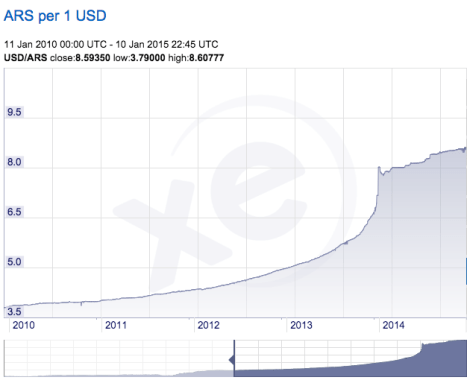
peso-to-dollarFiat money by definition has no intrinsic value. The only the value that fiat money has is the threat of legal force if someone refuses it. This is why the value of fiat money is directly tied to the legitimacy of the governments that issue those currencies. Right now, we are seeing a collapse of the Argentina peso (again), which is due to the government’s refusal to pay it debts. This in turn has lead to a crisis in confidence of the monetary stability of the peso, which has caused for a self-fulfilling prophecy of people and investors fleeing the peso.

As people dump the peso for other options (mostly dollars due to exorbitant privilege), the value of the peso goes into free fall because there is far too much supply and not enough demand. This causes for the value of the peso to plummet, and people want to get rid of their peso as fast as possible for something that can hold value. This can be commodities, cars, property, foreign currency, or anything that can help them store value and not quickly evaporate under the 56% inflation they are currently facing.  As this process builds, one of two things happens:

1. The value of the peso collapse far enough for supply and demand to meet, and the value will start to stabilize, abated after losing a signification amount of it’s value.

2. The peso is continually dumped, the value will go into almost total free fall, and hyperinflation will ensue.

It is important to understand that hyperinflation is linked to a dramatic rise in the velocity of money, as people are trying to transact with that money almost immediately, as people want to get what their money is worth, and not lose 50% of their purchasing power. Furthermore, this problem then tends to be exacerbated by government printing more money to try to deal with price increases, which further expands the money supply of a market that is already oversupplied with a money no one wants.  For more details on how hyperinflation and velocity of money operate together, please see this page.

Working Towards the True Value of Bitcoin

When we look at bitcoin from the lens of Gresham’s Law it is rather impossible to determine if bitcoin is overvalued or undervalued; as by definition, whatever the market price is today is the real value. Due to bitcoin’s total elasticity, the value of bitcoin can theoretically fluctuate from millions of dollars in a matter of minutes, with little changing in the market other than perception. If we look closely, there are several indicators which we can use to see if bitcoin is undervalued or overvalued. Some of these indicators are the transaction volume, the cost of bitcoin mining, the number of market participants, and the bitcoin day’s destroyed metric.

The transaction volume can act as an indicator of the equilibrium of the bitcoin market. We can assume that generally if the value of bitcoin is overvalued, more people will spend their bitcoin than fiat; wheras if bitcoin is undervalued, people would rather spend fiat than bitcoin. However, both miners, and bitcoin based business both need to sell bitcoin for fiat to pay their bills–which in the case of the price dropping precipitously, these buisness would need to dump even more bitcoin, which would accelerate the drop in price. This can lead to dynamic disequilibrium, which is essentially when the market has lost its collective mind, and the euphoria or panic of the digital herd dictates the market and creates a self-fulfilling prophecy that is totally unrelated to the commodity value of bitcoin. What can be seen in any situation of disequilibrium is the velocity of bitcoin is much higher than the norm.

Velocity Adjustment of Bitcoin

If bitcoin is undervalued, than transaction volume will continue to drop, tightening the money supply until equilibrium price has been met. If bitcoin is overvalued, then the supply cannot meet the demand, and the price will rise until equilibrium is met.

The value of bitcoin pulled between the social value of the network at the current time (short-term), verses the total electrical expenditure that has been spent to create the bitcoin supply today (long-term). This creates a moving target for what the ‘true value’ of bitcoin is. The higher the velocity compared to the historic gross average velocity of bitcoin, the greater the chance of bitcoin’s price being in disequilibrium. The lower the velocity compared to the historic norm, greater the equilibrium there is.

The fixed supply of bitcoin ensures that the only way to adjust the monetary value of bitcoin is through exchange. When the price is undervalued or overvalued, the transaction ratio compared to the norm will be much greater.

Conclusion

When comparing digital currencies and fiat currencies directly against one another, it is quite clear that digital currencies are very undervalued at this time. There is a clear limit on the number of bitcoins that can be forged, they are backed by the real electrical energy that is expended on bitcoin mining, and there is a huge amounts of VC capital going into building the bitcoin ecosystem. This is no different from the expenditures that go into mining operations for gold, silver, platinum, or fossil fuels. Furthermore, bitcoin and other digital currencies are digital natives, living in the realm of the internet; which is the largest and fastest growing economy in the world. Goverments and their fiat money will always be interlopers in the transglobal internet. Chained to the states they are from, with the slow, inefficent, and backwards idea that state-based fiat money work will in a transglobal economy, they will succumb to the creative destruction of bitcoin. When looking back on 2015 from the vantage point of 2025, it will seem laughable that digital currencies didn’t immediately usurp fiat money. We simply need to look to the history of the failure of fiat currencies to understand that it is not a question of if they will fail, but when.

The issues of the financial crisis of 2008 were never addressed, which has made the entire financial economy today into one huge moral hazard. This empire of paper will topple soon, and it is refreshing to know that in that process, we will be able to take back our financial power, and strike at the very heart of state-capitalism.

Next: The Transaction Cost of Bitcoin

Bitcoin and The History of Money

To understand Bitcoin, we need to also understand the history of money. This is a long and complex topic that has changed dramatically over the last 400 years, and has a total history of more than 3000 years. In order to understand both money, and bitcoin, we need to understand that there are two distinct functions that money has, that are independent of each other, but both influences money’s value: the payment function of money, and its storage of value function.

Both of these features have important functions for money, but it is important to understand how each one of these affect money differently. I cover this in more detail in what is the intrinsic value of bitcoin, and bitcoin as commodity money.

The best way to think of it is that bitcoin is a threat to both common storage of value; such as precious metals like gold and silver, but it is also a threat to normal fiat money because of the bitcoin payment network. These two features of bitcoin create one type of money that is superior to both precious metals and fiat currencies. To understand why bitcoin works as money, we need to understand the history of money over the last century.

The History of Banking

To understand banking, we need to know what is a mode of exchange, how did it come about, and why it was needed in addition to a storage of value.

A mode of exchange is just that, a mode in which you can engage in the exchange of one good for another. Before modern money, this could be anything that was commonly exchanged, and the value was well understood by the general public. Throughout history, this has been everything including bushels of wheat, tobacco, land, etc. As long as both parties understood the value of what was being exchanged and chose to accept it, it could function as a mode of exchange.

As gold became the common standard for exchange during the mercantilism era, there became substantial risk in carrying large amounts of precious metals. Instead of carrying around a brick of gold, people could carry around notes that were redeemable at banks for the same amount of gold as the note. This is how banking has been practiced for most of its existence. It has only been in the last century that fiat paper money with no convertibility to a commodity has become the norm.

It is substantially important to understand that fiat money came about to represent an actual storage of value to make real payments. The only reason fiat money ever did come about is because it was a technological innovation that was fiat money. To be able to spend the value of gold, but carry it around in a lighter paper form what a huge technological development that fundamentally changed how exchange was preformed. This allowed for people to continue commerce in the same ways as before, but now with their wealth from the threat of theft.

Ironically, the creation of banking notes that can be redeemed for a storage of value also created the needed framework for the current system of fractional reserve banking that all states use today. This created a kind of banking system where banks no longer operated on how much money they have available, but they operate on only a fraction of the total they should have available. Banks use this system to cheat their profits by using the multiplier effect to multiply their profits–and their losses. These losses can become so substantial that it can destroy the entire banking system and economy. This is what happened during the Great Depression, and more recently during the 2008 meltdown.

The Bretton Woods Era

near the end of WWII, the allies came together in secret meeting in Bretton Woods to negotiate how the new global economy would be built. Keynes wanted an International Clearing Union which would use a fair international banking currency based off of trade deficits called the Bancor. This became the official position of the UK when negotiating at the BW conference.

Keynes’ idea was rejected (despite its popularity), and instead the dollar was to replace the international currency unit, which today gives the U.S. a special power in international finance call exorbitant privilege. To do this, $35 was set as the redeemable price for one ounce of gold (almost twice what it was worth when it was seized from U.S. Citizens back in 1933), and what would become the IMF was setup. Keynes understood the huge issues this would create in international monetary system, and offered incredible insight to how this would play out 20 years later.

This system would have worked, if the U.S. was not cheating on their balance of payments. From 1945 to 1971 more and more U.S. dollars started circulating around the globe because the U.S. was importing more than they were exporting–creating a negative balance of payments. In fact, so many dollars were exported like this that the U.S. could not cover all of the outstanding gold that the dollars represented. The French were suspicious of this in the 1960s and started to repatriate their gold, which led to Nixon shock. In 1969, Nixon announced that the dollar was no longer convertible to gold, and created a 10%  tariff to protect american industries from the shock of this. $35 was no longer worth an ounce of gold–it was worth nothing.

Nixon Shock

In order to make sure that the dollar did not enter into a death spiral of hyperinflation, Nixon as put in place tariffs, wage freezes, and a fixed exchange rate until he figured out what to do to give the dollar value. In 1973, Henry Kissinger struck a deal with the Saudi King. In exchange for arming and supporting the Saudis and their brutality domestically, they would agree to sell oil in only U.S. Dollars. This created the ‘petrodollar‘ which propped up the value of the dollar now that it was no longer exchangeable. So from 1973 on, the dollar was no longer worth gold, but oil.

Nearly thirty years later we can see the evidence of how decoupling the dollar from gold has shattered faith in the global monetary system and the dollar. This had huge consequences for the purchasing power of the dollar and everyone who used it. Below is a chart of the purchasing power of the dollar since 1970–today the dollar of 1970 can only purchase $0.18 of goods today–it lost more than 4/5th of its purchasing power in just 45 years.


The Theft of The World

Now that money was no longer tied to the actual value of commodities and is free-floating, it became possible for the theft of the productive capacity of not just entire nations, but the world itself through the monopolization of money by state governments. Slowly over decades, inflation simply caused for the slipping purchasing power of not only the dollar, but all fiat currencies. This was done so slowly and deliberately that few could understand what Keynes had warned people of so many years before:

“Lenin is said to have declared that the best way to destroy the capitalist system was to debauch the currency. By a continuing process of inflation, governments can confiscate, secretly and unobserved, an important part of the wealth of their citizens. By this method they not only confiscate, but they confiscate arbitrarily; and, while the process impoverishes many, it actually enriches some. The sight of this arbitrary rearrangement of riches strikes not only at security, but at confidence in the equity of the existing distribution of wealth. Those to whom the system brings windfalls, beyond their deserts and even beyond their expectations or desires, become ‘profiteers,’ who are the object of the hatred of the bourgeoisie, whom the inflationism has impoverished, not less than of the proletariat. As the inflation proceeds and the real value of the currency fluctuates wildly from month to month, all permanent relations between debtors and creditors, which form the ultimate foundation of capitalism, become so utterly disordered as to be almost meaningless; and the process of wealth-getting degenerates into a gamble and a lottery. Lenin was certainly right. There is no subtler, no surer means of overturning the existing basis of society than to debauch the currency. The process engages all the hidden forces of economic law on the side of destruction, and does it in a manner which not one man in a million is able to diagnose.”
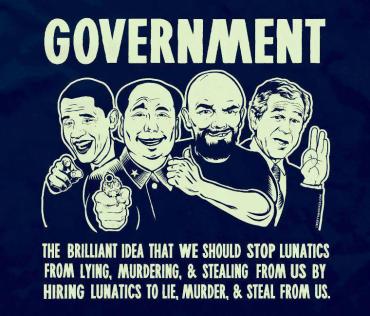
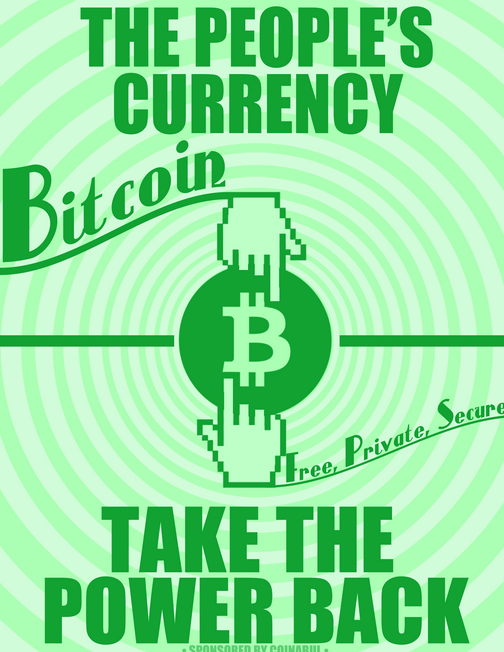
–JMK, The Economic Consequences of the Peace (1919)

Today the inflation that we face is not due to new gold being introduced to the fractional-reserve banking system, but from the value of the dollar simply decreasing.  Today there are more dollars in the world today than yesterday due to quantitative easing (i.e. making more dollars). The decrease in the purchasing power of the dollar is a direct loss to you and everyone using the dollar; and a direct gain for the government and banks who benefit from the creation of new dollars. We have been told that these are good men, and that they will use monetary policy to create price stability and keeping unemployment low, but the facts show something much different and much more insidious. 

Failure of Gold as a Storage of Wealth

Gold has been used as a storage of wealth for millennia because of the total fungible nature of gold. However, what happened from the start of the 20th century, to the end of WWII, was a consolidation of gold in the hands of the State through legal confiscation and violence. By 1973, almost all gold was in the hands of the state through force and theft.

This was done in two distinct ways. There was state-to-state confiscation of gold and precious metals, such as the reparations from WWI and imperialism. This concentrated gold in the global north in the hands of a small number of elite bankers and business magnates. The other way was through the war that governments carried out against the private wealth of their own citizens.

This can be seen throughout the world with the restrictive legislation from states around the globe; such as Executive Order 6102, The Australian Banking Act 1959, and the Indian Gold (Control) Act 1968Instead of protecting citizens from the tyranny of wealth seizures, holding gold actually made people a target for the state. Through this violent seizure of wealth, governments essentially gained an oligopoly on gold. This allowed for governments and their allies in banking to manipulate the price of gold through holding or dumping; but more importunately, they have rendered gold meaningless as a source of payment and storage of value. Today, almost no one will take your gold or silver as payment, despite the fact it truly is worth more than paper money.

The Need for Protection From The State

It should be obvious that the greatest threat to ones personal wealth is not some foreign or personal aggressor, but the State itself. This puts us in a predicament because the State is the owner of the means of exchange, and the arbitrator of all legality. Through controlling the means of exchange, the State can manipulate the value of the dollar on a large scale for its own benefit (such as quantitative easing or unlimited funding for war), while also being the gatekeeper of the finance system. The greatest issue with this is that even if you find a suitable alternative means of exchange (like bitcoin), the state can still call it illegal, and bring violence to you and your family for not complying.

If one is to control a large portion of wealth, it can only be done with the explicit approval of the State. At any time they can choose to seized you wealth, and you can go to prison. The accumulation of large amounts of wealth becomes impossible without the approval of the State in modern society. If the State does not approve of it, they will call it ‘money laundering’ and treat you as a criminal. This means that it is impossible for someone to be against the state, while still being able to control their wealth. This helps explain why the state is so active in financial oppression against its own citizens, while allowing for out right crimes to be preformed by some of the largest banks in the world, and letting police execute its citizens.

This explicitly displays that the State has the power to stop these criminals today,  and yet they choose not to do so. This is because the government is in bed with these organizations. Politicians receive ‘donations‘ from these companies and former CEOs are given elite, secure jobs from the government later down the line in exchange for this. These companies have bought laws and protection for themselves at the direct expense of other citizens through the corruption of the legal, and political system. It should be clear and obvious for all to see: we cannot recover this system of government, economics, and finance, and we must reject the system as a whole.

Now that we have bitcoin, we can actual do that. Once we reject the money of the State, and their crony capitalist bankers, the value of their fiat money will collapse. The State will no longer be able to pay for their wars, bloated salaries, or mechanisms of fear and terrorism. There will be a great unwinding and no one will accept their shitty paper money anymore.

Conclusion

bit-freeThe State over the course of the last hundred years has pulled off one of the greatest stunts ever: getting people to believe that paper is worth more than real commodities. Through the slow theft of gold for paper, people have been robbed of their ability to have independent wealth. Wealth today can only be acquired at the good will of the State because the State monopolizes the legal authority for how you can get money. The State, and their banker allies siphon off as much value as they can from the productive capacity of normal, hard-working people through devaluing fiat money through quantitative easing and interest.

From the end of gold standard in 1933, to all of the usurpation that brought us to where we are today, it should be clear that governments cannot be trusted with our wealth. Bitcoin and digital currencies offers people a chance to have a financial system that does not empower the State, or elite banks, but protection us from them.

Bitcoin is a global payment system, and storage of wealth that allows for a new system of finance and economics to be built. One based upon the principals of mathematics, privacy, and provability. A new system where we are not punished for saving and protecting our wealth, but rewarded. A system that understands, respects, and protects people’s right to privacy, and their right to conduct commerce with anyone in the world, no matter what State has their bootheel on their back, demanding a portion of their wealth.

Change is coming, and it will be radical, and it will change the world for the better.

Next: The Absolute Value of  Crypto

Capital Exit, Capital Strike

“If a thousand men were not to pay their tax-bills this year, that would not be a violent and bloody measure, as it would be to pay them, and enable the State to commit violence and shed innocent blood. This is, in fact, the definition of a peaceable revolution, if any such is possible.”

-Henry David Thoreau,

Civil Disobedience  

 Capital Exit

In his 2013 Startup School talk, Balaji Srinivasan, the CEO of 21.co the bitcoin computer, proposes the idea of Silicon Valley’s Exit. It’s a brilliant talk and I highly recommend watching it. I have to wonder after watching it if he really eluding to is that Silicon Valley already is exiting?

Software has eaten the world alright, and bitcoin is the software of money. These are arguably some of the best investors in the world who specialize in high-tech, and they are the ones that are the most excited for bitcoin and digital currencies. They must know that bitcoin cannot be seized if the right precautions are taken. They understand that bitcoin and digital currencies are a very real and meaningful exit for capital from the current system. Not that Silicon Valley itself is going to outright secede from the union, and dump all of their money into digital currencies–Heaven’s no. They are simply going to build the tools so people can make that choice for themselves.

Nearly a billion dollars has been invested into the bitcoin ecosystem by VC firms, and that number is growing at a rapid pace. These investments are not direct investments in bitcoin itself, but into companies that are building the architecture around digital currencies–this is the dawn of digital banking. The banking system in desperate need of something to replace it, and bitcoin is just the thing to do it.

Both banking and finance are ripe for disruption and there are huge markets that digital currencies can realistically replace. Today remittance transactions can be done with bitcoin for practically nothing and can reduce consumer fraud to practically nothing. When you consider that remittance transaction are a $500 Billion dollar a year market and that merchants spend $3.5 billion a year in fraud cost each year these are just too big of markets to be ignored.

Remittance flows: Taking over this market is the real target of Bitcoin

The opportunity here is just too good because this is a totally new market. Banking and finance have been a monopoly for a very long time, and when you smash monopolies, you create new markets. Digital currencies are trying to smash the largest and most powerful monopoly that has even been created: Fiat money.

To free capital from the chains that banks and government have wrapped them in is revolutionary in scope, and monumental in size–like the internet, but bigger.

Digital currencies will engage in Schumpeter’s creative destruction and eat the world of finance, banking, and eventually governments themselves. Ironically, Srinivasan and the team at Andreessen-Horowitz may be investing in the very architecture that is going to destroy their system of capitalism all together, and evolve it into a tool for something much greater than the small, oligarch system it is today.

This is the ultimate exit; the one where we build a new system of finance, economics, banking, and government itself to serve anyone with an internet connection. We can use this system to ensure that the violence they want to bring to our bodies can never be done, because they can never find out who we are, or where we keep our money.

Capital exit from fiat currencies and moving to a digital currency is not only an incredible profitable move–it is a righteous and just one too.

Capital Strike

Digital currencies are not just an alternative new money, they are an implicit rejection of the current economy systemAnyone who wants to can organize their own capital strike can simply reject the economy system they have been forced into. Be it that you are tired of getting fucked by late fees at your bank, having ANY government steal your money to fund their wars, or you simply don’t trust having a bank account (as you should not), then bitcoin can help you fight back.

Bitcoin levels the playing field because people now have choice. You can use the bitcoin system to save and move money, or you can use the banking system.

Their system is one of 9-to-5 bullshit jobs, college tuition that is out of the reach of most Americans, and one where government-issued money WILL devalue by 33% over the next 20 years. This is a system that enslaves more people of color than at the peak of slavery in the US, while allowing for banksters to fund terrorist and get away with it. It is quite obvious that this system was not made to benefit you or me, but a very, very small, elite class of people. That is not a system I want anything to do with, and so I am walking away from it.

With bitcoin anyone can walk away from this system, and build something for themselves. Anyone can post an address online and sell their own items, labor, skills, or talents within a huge market that is totally independent of the State and banks.

Sure it’s risky, but you know what? It’s a hell of a lot better then giving your money, time, and labor to a system that is designed to impoverish you.

Opportunities are endless for anyone to join and to build what they want for themselves in the bitcoin ecosystem. The only promise I will give you is that the protocol will not lie–and that is enough to challenge their system of money that is built upon lies and theft.

Either our government has the power to right the wrong and unconstitutional actions this government has engaged in, or they are powerless to do so. In either case, they have proven themselves unfit to govern a people that call themselves free. The tools at are at your disposal, you are free to make the decision for yourself and join us with what we are building.

Either way, I don’t care what you do. What we are building cannot be stopped or denied, and it will change the world.

Next: Bitcoin’s People Problem