Zombie GOX: The magical price increase

In recent months the fall out from the GOX fiasco has really weathered bitcoin. From seeing its highest price of around $1126 and a low of $394, the market has weathered some amazing news, mostly due to the fails of the largest, now defunct bitcoin exchange MtGox. MT. GOX (frequently called Mount Gox, is really an abbreviation of Magic: The Gathering Online eXchange) closed its doors and officially announced bankruptcy, stating that they had been robbed of most of their bitcoins. But since then there have been some rumblings of foul play from the like of The Idiot, and some concerns with coins that have tainted links to Mtgox. What I suspect is that Mark cut a deal.

In this deal in exchange for relinquishing control of the business (and hopefully facing criminal negligence charges as well) Peter Vessenes will drop the Coinlab lawsuit. Together, Peter and Jon will use the bitcoin collected for membership at the Bitcoin foundation to both inject funds into MTgox and give The Bitcoin Foundation a share of MTGox. They’ll rehabilitate the business and inject huge sums of money (both fiat and bitcoin) into the market to inflate themselves away from a fractional reserve bank.

This is a sweet deal for everyone because Mark will get off the hook lighter than if all of the coins were gone. Peter gets what he wanted from the Coinlab lawsuit. Jon gets the make the Bitcoin Foundation the Hero, and can show their role in helping create self-regulation. And Gox gets to become the largest exchange in the world again as the price per bitcoin pushes beyond $3000.

I know this is kinda dirty, and that is why the idiot is crying so much about it, but I also think this is what can propel bitcoin into the next big bubble. If GOX is bailed out by the foundation, it makes them look competent, shows that the foundation is more than a mouth piece, and can help legitimize The Bitcoin Foundation for these kind of crises. I also think to do this a ton of shade backdoor deals were made, and there is going to be a huge pump of capital all at the same time. This will both save GOX and push the price up several fold.

The coming days will be interesting…

The Economic Functions of Bitcoin

The economic functions of the bitcoin network causes it to behave like a central bank. This has a few effects: bitcoins (the payment unit) behave like stock due to the fixed, known supply of units being subject to open market operations. What happens when the market price of bitcoin changes is the velocity of bitcoin falls into disequilibrium until a new equilibrium is found. This is why the transaction volume of bitcoin its extraordinarily high during the bubble cycle, both on the way up, and on the way down. From this observation we can see the velocity of bitcoin also serves as the price finding mechanism for the immediate price of bitcoin. Before we dive in deeper, lets first take a look at how bitcoin acts as a private bank in the digital world.

Bitcoin: The Private Bank for The Digital World

If bitcoin was a private bank it would have the following maxim as its monetary policy:      

  • Whomever secures the Network shall be reward 50 bitcoin with each new block. This amount shall decrease by 1/2 every 210,000 blocks until it cannot be halved any longer.

This is the issuance of bit-coins, the currency unit, is made from the electrical energy spent mining bitcoins. We can see the monetary inflation schedule for bitcoin below. The supply of bitcoins is 100% totally fixed–the only way that new coins can be created is through solving a specific block, and the reward for that is drops every 4 years.  

bitcoin supply growth over time

bitcoin supply growth over time

In order to have a money system that needs no central authority, Satoshi made bitcoin based upon rules that are fixed and secured by the mining process. This allows for a system where all bitcoin units are known at all times, thus making the double spend problem solved.

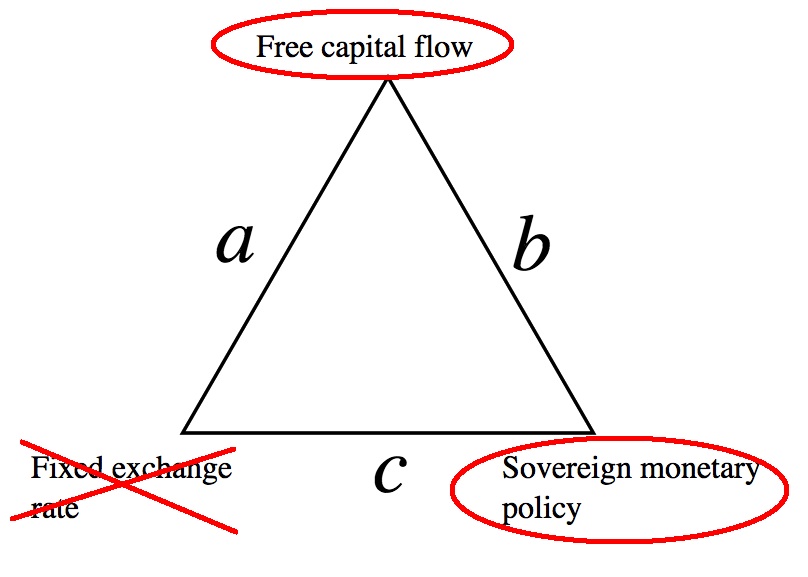
trinityIf bitcoin is a central bank, it would have to solve the impossible trinity problem that all central banks face (except the U.S. but that is a different story). Bitcoin accomplished this by creating a computer program with an independent monetary policy that humans cannot interfere with. The block reward, how the competition for the block reward is done, and the fixed supply of units are all parts of the bitcoin program that cannot be changed.

Anyone with a bitcoin address can use bitcoin, and it is impossible to know who is controlling each address, so bitcoin must be freely exchangeable. This means that the ‘sacrifice’ that bitcoin has made in terms of the impossible trinity is that it has no fixed exchange rate–the market must find an exchange rate based upon bitcoin’s perceived value, and the number of units available to the market. This free flow of capital from any sources is what allows for bitcoin to have been worthless just a few years ago, and why it could be worth $10,000s per coin one day. The free flow of capital is what creates the total elasticity that bitcoin experiences. 

Bitcoin and Deflation

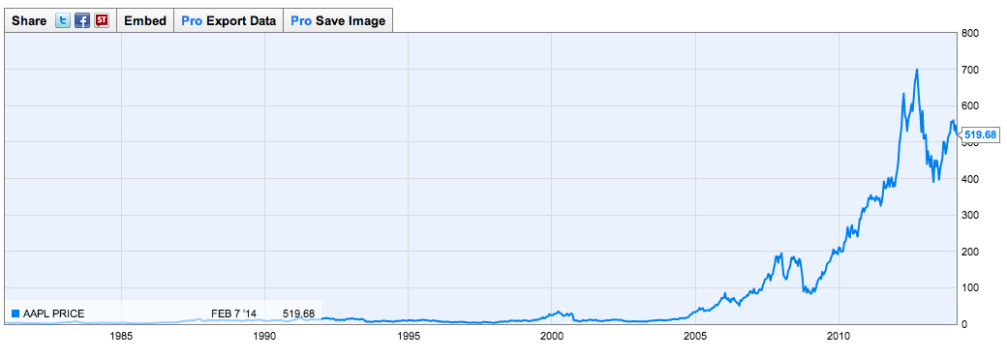
When economist have called bitcoin deflationary they are referring to its economic property of rising in value over time. This is due to the restricted supply of bitcoins while there is increasing demand for them. This is similar to how if you had bought Apple stock in 1980 during its IPO you would have paid $22 per share. Due to the restricted supply of Apple stock and the increase in demand, today it is valued at $520 per share–and that is after 3 splits.

apple price

You could say that Apple stock “deflated” in value.

This occurred while the supply of the stock (# of shares) of Apple increased–it inflated. On three different occasions Apple had their stock split increasing the total number of Apple stocks there were. Again, this is due to the dramatic increase in demand for the stock. This is the kind of deflation that Bitcoin is experiencing overall, despite the volatile ride bitcoin has had over the last few year.

Why Deflation Supposedly Bad

Deflation is bad according to modern monetary theorist who charade as economist because contemporary economies are based upon debt. Fractional reserve banking and debt cannot exist without one another, so when deflation happens, it happens to debt as well. This means the real value of debt becomes harder to service, which means defaults, and bankruptcy will increase. In 1931, Irving Fisher  presented his theory on debt-deflation, which explains this process in greater detail.

This kind of deflation does not happen with bitcoin. There is no need to service ‘debt-bitcoin’ with bitcoin, so debt deflation does not happen. If this were true, we would see a similar collapse in the velocity of bitcoin during deflationary episodes, but in fact we see the opposite. The velocity of bitcoin increases correlatively to the price change of bitcoin in the short-term.

The Price of bitcoin

The price of bitcoin is derived from the total utility of the bitcoin network. In otherwords, bitcoin’s value is specifically tied to how many people are in the network, how useful the network is, and what the perceived value of bitcoin is. This is similar to how Twitter and Facebook have created social value that has translated into real economic value; which is reflected in the stock price of both of these companies. Without their userbases, each one of these networks would be worthless. All networks have a hidden utility that translates into direct economic value. 

The value of bitcoin is based in part off of this network abstraction. In order for price discovery to happen individuals need to use their subjective preference to decide how much each bitcoin is worth, and how much the network itself is worth. This is how the general, long-term price levels for bitcoin are discovered.

The short-term price is discovered according to network externality, such as exchange failures, or political issues. An example would be how bitcoin is ‘more expensive’ in Argentina because of the high rate of inflation that the peso is experiencing. Another would be the dramatic drop in price, and then recovery after the Silk Road was shut down. These network externalities, unlike fiat money, causes for great volititly in the price because there is no goverment to fix the price of bitcoin; only the market. The price of bitcoin reponds to these events through change, which causes for the velocity of bitcoin to increase until a new equilibrium is found.

The Velocity of Bitcoin

Due to the fixed supply of bitcoin, the only way that the price can be adjusted is in one way: through exchange and transaction. This is why during the most volatile times of bitcoin, we see a higher transaction volume. This applies to both increases as well as decreases in the price. Due to the fixed supply of bitcoin, the only way someone can acquire bitcoins is to mine them, or to buy them. Thus if the price of bitcoin is to increase or decrease in ANY WAY, an exchange or transaction must take place for that value to be accounted into the market.

Conclusion

Bitcoin’s deflation is similar to a technology stock where individuals are making real gains though holding a risky asset while it grows. Because bitcoin has a fixed monetary supply that cannot be manipulated, the price of each bitcoin is determined through supply and demand mechanisms. This is reflected in the increase of the velocity of bitcoin. If bitcoin were facing true currency deflation, we would not see the velocity of money decrease.

Next: Gresham’s Law and Bitcoin

The Barbarians of Government

In a recent New York Times Op-ed “Bits and Barbarism,” Paul Krugman resumed his bashing of bitcoin, gold, and everything that is not government issued money. He presents an idea of how bitcoin and gold are ‘barbaric’ forms of money because of the resources that are expended to obtain them, while government ability to create money is good because it can spend that money to create positive economic output. The irony of Paul’s argument is he completely fails to see the barbarism of the United States, its imperial military, and the way that government money creation empowers such barbarism. Paul wants for the government to be our savior, but fails to see that governments created the economic situation we are in today. Bitcoin provide an exit from this tyranny that men like Paul cannot see because of their entrenched position within the interest of the wealthy from atop his ivory towers.

Paul thinks that the government has a serious vested interest in creating full employment and encouraging economic activity. However, when we look at the political-economic structure in this country, it is clear that something else is happening. In 2012 less than 32,000 people accounted for 28% of all political donations in 2012–that’s almost 0.01% of the population getting about 1/3 of the political voice of all the other voters combine. J.P. Morgan Chase, one of the richest companies in the world, has spent more than $100 million dollars on lobbying and political donations, and this has paid off for them handsomely. The International Monetary Fund estimates that J.P Morgan Chase receives about $14 billion dollars a year in subsidies–about 140x as much as they spent on political manipulation.

When we look at these figures we must understand that this is how the political system works. No amount of hope or objections will change that. Paul seems to think that creating positive economic change is simply about creating sufficient will power to create that change. He fails to see how the whole political system has been compromised by none other than the heroic government that he wants to see change it.

Now that we understand where Paul is coming from, we can address some of the points in his article.

Gold

Krugman opens his article with talking about the human rights violations that are occurs in gold mines, like the Porgera gold mine in Papua New Guinea. He then goes on to talk about how the desire for gold is to blame for such gross human rights violations, but fails to point out that this mine he mentioned is managed by the Canadian mining company Placer Dome. Paul seems to think that the western government of the world have some vested interest in preventing human rights violations. If that is so, than why would they not come down on companies that are facilitating it?  To most of us it is pretty obvious–governments get kickbacks in the form of lobbying and political donations, in exchange for allowing large corporations to violate human rights abroad. It is disingenuous to talk about human rights violations, and then turn around and defend the governments that allow for those violations to occur.

Bitcoin

Paul then moves on to talk about how bitcoin mining engages in a similar wasted expenditure of energy similar to gold mining. He actually sounds like he really doesn’t understand how the block reward is distributed, which could be part of the problem. Paul does not understand the value of a P2P digital payment system that is out of the control of governments. He does not even see how it could have value. To him, bitcoin is just another commodity money like gold, which also should not have value.

This is critically important to understanding the elitist world view that Paul presents. Paul writes for the NYT, went to Yale for his undergrad, and M.I.T. for his Ph.d, and is a professor at Princeton. I’m sure that he has never been on the wrong side of the law, nor would he ever understand why you would be. He believe in the goodness of this government because he has always gotten the goodness of this government because of the elite position he occupies in society. Trying to tell him that maybe we need financial privacy because the government is proven to be corrupt and thieving doesn’t make sense to him–to him, these are the good guys, so why would you ever want a way to defend yourself from them?

Fiat

Paul then move on to talk about fiat money, and how in theory burying money and allowing for companies to struggle to extract the money would be a way to create real economic output. He uses this analogy to display that the extraction process of gold creates real economic output, in the same way that burying money could. He does this to show that the government can use their power of seigniorage (creating money from nothing) to create real economic output.

As true as this theory is, it is not the way that the governments have used their power of seigniorage. Instead this power has been used to give free money to the wealthiest organizations in the world: banks.

In Paul’s fantasy world, this is providing banks with the capital that they can then pass on to the little guy to create economic activity. What is really happening is the banks are just fattening themselves with free money in order to have the highest stock returns in recent history.

Government Role

Paul then moves on to quote Adam Smith on how gold and silver are ‘dead stocks’ to animate how wealth gets tied up in precious metals and then sits around doing nothing. What is very odd about this is if you read “The Wealth of Nations” you’ll see that this idea of gold and silver being a ‘dead stock’ is because gold and silver are hard to circulate. Smith saw paper money as being a technology–an innovation that allowed for all of the value of gold or silver to move about through a paper medium.

In many ways, bitcoin is the fusion of the ‘dead stock’ of precious metals, and the circulatory power of fiat money. Smith knew that gold and silver were the bases of the mercantilist world that he lived in, but he saw how damaging the hoarding of gold and silver was to the wealth of the nation because it wasn’t doing anything. This is why he thought that paper money was a good–though imperfect–method of engaging the value of the gold and silver. Smith states,

“The judicious operations of banking, by substituting paper in the room of a great part of this gold and silver, enable the country to convert a great part of this dead stock into active and productive stock.”

Gold itself was not the problem, it was making gold into an active stock that could be used everyday that was the problem, and bitcoin solves this problem.

Near the end of the article Paul asks, “So why are we tearing up the highlands of Papua New Guinea to add to our dead stock of gold and, even more bizarrely, running powerful computers 24/7 to add to a dead stock of digits?” To me, this actually displays Paul’s lack of understand of how bitcoin works, because unlike gold, bitcoin is not a ‘dead stock.’ It is clearly used as a medium of exchange, while at the same time being storage of value, hence fusing the idea of how fiat money and gold have classically worked.

Paul concludes the article with this:

Talk to gold bugs and they’ll tell you that paper money comes from governments, which can’t be trusted not to debase their currencies. The odd thing, however, is that for all the talk of currency debasement, such debasement is getting very hard to find. It’s not just that after years of dire warnings about runaway inflation, inflation in advanced countries is clearly too low, not too high. Even if you take a global perspective, episodes of really high inflation have become rare. Still, hyperinflation hype springs eternal.

Bitcoin seems to derive its appeal from more or less the same sources, plus the added sense that it’s high-tech and algorithmic, so it must be the wave of the future.

But don’t let the fancy trappings fool you: What’s really happening is a determined march to the days when money meant stuff you could jingle in your purse. In tropics and tundra alike, we are for some reason digging our way back to the 17th century.

This is just a lie. $1000 today is equal to the purchasing power of $353 dollar in 1980–which I would say is a hell of a lot of debasement. Furthermore, how is an inflation rate of +10% in 28 countries ‘rare’? What men like Paul fail to understand is that the government is not our savior, but a tyrant.

All of the economic woes of today could be end with the stroke of a pen from our government. The government could build huge public works programs, nationalize the banks, and take homes from the banks and give them to homeless.

But they don’t.

They don’t because there is no economic incentive for them to care about the poor, about the slow death of the economy for the middle class, or of even acting like they want to help us. The average American’s net worth has dropped 8 percent during the past seven years, while members of Congress got, on average, 15 percent richer. The only explanation for congress members having on average about 10 time the average wealth of americans, is that their corruption offers them special privileges, at the expense of everyone else.

This is why people are choosing commodity moneys over fiat money. We see the criminals that these people are, and the way that they are destroying the true wealth and industriousness of this nation. We want a money they cannot control, because they have proven time and time again that they cannot be trusted to control the wealth of a nation. Don’t let the rambling of a foolish man in a professors clothing fool you–the governments of the world seek to be good masters, but they seek to be your master.

Financial Insurrection

How can one be compelled to accept slavery? I simply refuse to do the master’s bidding. He may torture me, break my bones to atoms and even kill me. He will then have my dead body, not my obedience. Ultimately, therefore, it is I who am the victor and not he, for he has failed in getting me to do what he wanted done.

-Mahatma Gandhi

The most powerful weapon that we have is refusal. Our obedience within this system of State-sponsored capitalism, where we are made debt slaves for wanting a better education, getting sick, or having a home, is far from a fair system–it is criminal in everything but name. If we are to stop this kind of abuse we first must refuse to participate in this kind of abuse.

For the first time in human history, we have the option of rejecting and refusing this economic system, and replacing it with something better–with digital currencies. By using digital currencies over dollars, we can refuse debt that is usurious, and challenge the state’s monopoly on the issuance of money. This places within our hands the ability to directly challenge the legitimacy of the State, as money is law; and if we can make their money be questioned, we can destroy this monster.

Refusal

The first step is refusal. Bitcoin offers us a way to refuse the debt bondage that this system has bequeathed to us, and allows us an avenue toward negotiation, if we choose to negotiate. By simply refusing to pay our debts, while keeping our savings and the money we earn in bitcoin, we can fight back.

Defaults are painful, and as we saw in the 2008 crisis, it can call the whole system into question. If enough people started defaulting on the $1.2 trillion dollars of student debt that is owed to the Federal government, we can force them into negotiating a jubilee. Through defaulting you can use direct action to make it clear that this debt is usurious and will not be paid. There is more power in showing your willingness to not pay them to make a point, than there is to paying them and begging for the terms to change–they will not.

Rejection

The second step is rejection. Bitcoin is a direct challenge to the financial system and the legitimacy of the State itself. We can unilaterally reject participating in their economy by rejecting their money and the taxes that accompanies that money. By rejecting the fiat money we can take direct action to the economic system itself.  We can refuse to have the humble amount we contribute to this economy to be taxes, and to prop up this government. There is no longer a need for my money to go towards war, or any institution the State uses to oppress people. I do not approve of it, and I will not let them use my hard earned money for such evil purposes. To surmise why we should do this, I offer a quote from Henry David Thoreau’s Civil Disobedience:

If a thousand citizens were not to pay their tax-bills this year, that would not be a violent and bloody measure, as it would be to pay them, and enable the State to commit violence and shed innocent blood. This is, in fact, the definition of a peaceable revolution, if any such is possible.

The peace revolution that Thoreau speaks of can now be ours. Through refusing to use fiat money and using digital currencies instead, we can make a stand, while also protecting ourselves from the inevitable economic collapse that is coming.

Rejection of this system is something that is inevitably going to happen. The State cannot win–their money is designed too poorly, they run their economy too inefficiently, and they have only managed up to this point because of their monopoly on the mode of exchange and legal violence. Through challenging government monopolies on money, we will make the inefficiencies of the current system of global finance clear. We will destroy the capitalist of the world of flesh and steel with a newer form of capitalism that is more efficient, more secure, and simply put, better. When the world comes to realize this, there will be a great reckoning that will culminate with insurrection.

Insurrection

The final step is insurrection. Digital currencies are a revolution in the area of economics, and they will be an inseparability part of global economy one day. Bitcoin offers a world with no gate keepers, no permission seekers, and no restrictions on the world we choose to build. Digital currencies operation on the maxim of the protocol: what the protocol commands is supreme, and the federation of the protocol is what allows for it to work. There is no way to cheat this system because it is out of the hands of individual men and facilitated by the program itself–there are no middle men needed. Through cutting out both the State, and the banks from all economic transactions, the cost of maintaining the State and the financial system does not need to be carried by us. Our financial system does not need us to pay fees to criminal banisters, or taxes to a tyrannical governments to use our own money–just an internet connection.

It is impossible for fiat money to compete with bitcoin over an extended time span. Fiat money cannot hold its value over a long time period, which is why the purchasing power of a dollar today has lost 95% of its value since 1913. The supply of dollars is inflating constantly, and particularly with the rounds of quantitative easing that we are seeing throughout the world today. Because the supply of fiat currencies are increasing today, and because there is nothing of commodity value backing fiat currencies, there is no way it can compete with Bitcoin.  As it becomes more and more apparent that the dollar is losing its value while the value of Bitcoin is rising rapidly, people are going to start questioning the legitimacy of the dollar itself. It is at this point, when the dollar’s value starts to be questioned that the legitimacy of the government itself can be questioned. This is where we revolt, this is where we gain our freedom and destroy the monster that has sought to keep us under absolute despotism in the name of safety and security.

Revolution

Since the failed uprisings of 2011, it has been clear that State-sponsored capitalism is failing. There has not been a time in recent history where people have worked harder, received less, and have so little opportunity. This is not from the failure of the State to protect its citizens, but the inherent structure of what States will do when they enter into alliance with oligarch enterprises. We all see the criminality of this for what it is. We know that they are thieves, criminals, liars, but up to this point they have been too powerful, and there has been too few alternatives–one simply had to participate despite ones unwillingness to do so.

But now there is an alternative. A mode of exchange that is economically superior which has the features of privacy imbued into the money itself, and is organized in a horizontal, decentralized platform. A money with a known fixed supply that cannot be changed, that is controlled by no state, and no individual actors–just the Network itself.  A totally transparent money which allows for you to see all the transactions in the network, while still protecting the identities of individual users. And it’s practically instantaneous to use, and no permission required from a bank or from a government–your money belongs to you.

What is to be done still remains to be seen. What is known for now is that there is a powerful new economic tool that fundamentally changes the way that we view money and the mode of exchange. This challenges the fundamental features of the State today, and the money that they print. I for one am convinced this is how the revolution will start, because people will always seek to become more free, and now there is no one to stop you from breaking free from the chains of financial tyranny any longer.

Next: Capital Exit, Capital Strike

The Political Ramifications of Independent Money

Bitcoin is a radical new technology that we do not fully understand the impact of quite just yet, and most likely, we will not for years to come. As this economy grows, evolves, and has more market participants, the itching question is, how will this affect the political situations of the world? At first glance bitcoin may not seem like much at all, but when you look at bitcoin through the lens that it is independent wealth controlled by no nation-state, there are some interesting questions that are called into play.

 Regulation is a moot point

There has been debate about the idea of regulation vs. no regulation and I really think that it is a moot point considering that as private individuals that own bitcoin, we are free to exchange with whom ever we please–no government required. Furthermore, people can protect their identity from any sort of interloping from the State, which means that Bitcoin is a truly free global commodity that cannot be stomped out by any government.

This is not to say that regulation will not effect the market, but rather, the market can exist, and has existed without regulation for the last several years. Moving forward, if there were to be anything that could seriously threatened bitcoin, or their users, there is nothing that is preventing bitcoin users from simply absconding their wealth into the internet, and turning up somewhere else in the world with it. With Bitcoin being recognized as private money in Germany, I see no reason for wealthy bitcoiners to consider tolerating any sort of regulatory intervention and losing a substantial portion of their wealth due to such interloping policies.

Our wealth is assured by math, our freedom is ensured by politics

With the imprisonment of Ross Ulbricht and the discussion of bitcoin red list, there is a very important principal being discussed, it is called a bill of attainder. This is the legal concept of a legislature declaring a group of people criminals or guilt of a crime by virtue of who they are, or how they are identified. What is important to understand is the possibility of having one’s wealth seized in a manner similar to how if you try to spend a forged $100 bill, the merchant won’t recognize the value of that money, they will just take it and turn it in to the authorities–and you will be out $100. By tainted coins that have been used ‘illicitly’ it calls into question the fungibility of all coins–something that would not be tolerated internationally. James Madison explained why bills of attainder are so dangerous in the Federalist #44 stating:

“Bills of attainder, ex post facto laws, and laws impairing the obligations of contracts, are contrary to the first principles of the social compact, and to every principle of sound legislation. … The sober people of America are weary of the fluctuating policy which has directed the public councils.  They have seen with regret and indignation that sudden changes and legislative interference, in cases affecting personal rights, become jobs in the hands of enterprising and influential speculators, and snares to the more-industrious and less-informed part of the community.”  —James Madison

This legal question has been answered–tainting bitcoin is illegal and unconstitutional. Bills of Attainder are prohibited on three occasions in the U.S. Constitution and also in all 50 State Constitutions. With that being said, things being illegal or unconstitutional has never stopped the government before, so there is no reason it would stop them now. The question is how far will both bitcoin-accepting business and individuals cooperate when various government agencies start tracking coins, their owners, and showing up at people’s doors, threatening them with grand juries, imprisonment, and violence for not cooperating? As much as I would like to think the government would be stonewalled, I also know that the FBI has a long and robust history of acting outside of the law in very illegal ways, and convincing people that cooperation is the only way. It will be interesting to see how governments treats our physical bodies when they cannot seize our wealth.

State Against State

The most important feature that bitcoin offers in terms of regulation, is how states are going to position themselves in what will eventually become a game of State against State. Most interestingly, the U.S. is the one nation that has the most to lose here, when you start to consider that bitcoin can very realistically challenge the dollar’s global reserve currency status. This is perhaps what we are already seeing with bitcoin’s dramatic rise in China, with their government remaining rather quiet on the issue. Perhaps they are exploring the idea of using digital currencies to weakening the United States Dollar’s death grip global commerce–it will be interesting to see.

The most important fact to bear in mind here is that bitcoin is superior for international commerce in totality. It is faster, cheaper, more secure, and has less oversight than any fiat currency or precious metal. This means that bitcoin is inherently economically superior to the USD as a reserve currency, and challenges the exorbitant privilege of United States. As bitcoin grows and incorporates itself in more and more markets, it is going to seriously challenge the worth of fiat money itself. States like Germany that choose to adopt a sensible policy will do well with their admission that they cannot control the currency, and to simply treat it as a private currency. States try to restrict and control bitcoin are just going to shoot themselves in the foot hamper their own commercial activity.

World Citizens Against States

The most powerful political ramification of bitcoin and digital currencies is that it creates a new class of international world citizens–a people who’s wealth and prosperity is not linked to that of boarders or territories. When we consider that 16 countries have inflation above 5% today, why would people ever choose to hold paper that is losing value everyday? When people discover there is a way to protect their wealth against the tyranny of inflation, I see no reason why they would not.

But this calls into question something that is clear for most bitcoiners today: Fiat money is garbage. The only reason it is useful is because the state forces us to use it. That does not make it better in any way, and perhaps it makes people very spiteful. Keynes understood this point, as we can see below:

By a continuing process of inflation, governments can confiscate, secretly and unobserved, an important part of the wealth of their citizens.  By this method, they not only confiscate, but they confiscate arbitrarily; and, while the process impoverishes many, it actually enriches some.  The sight of this arbitrary rearrangement of riches strikes not only at security, but at confidence in the equity of the existing distribution of wealth.  Those to whom the system brings windfalls . . . become ‘profiteers’, who are the object of the hatred of the bourgeoisie, whom the inflationism has impoverished not less than the proletariat.  As the inflation proceeds . . . all permanent relations between debtors and creditors, which form the ultimate foundation of capitalism, become so utterly disordered as to be almost meaningless.

These ‘profiteers’ that Keynes speaks of are the bankers that today are richer than they ever have been, despite having caused the economic turmoil that we are all in today.  As we move into the future, the gap between the rich and the poor is just going to become more extreme. It is clear that the State has failed to protect its citizens from the destruction of state-sponsored capitalism, and it will be up to the people themselves to find the protection they need from both the State, and from their crony capitalist allies.

Once people come to understand that incredible gains they can personally have from using digital currencies, there will be very little reason to continue using fiat currencies. This will then push forward the crisis of confidence that we are already seeing with governments around the world. The final step to ensuring that these governments crumble into nothing, and that something else can be erected in their place, is when their money simply stops being accepted by people. Once that occurs, there is nothing these governments can do–they will have lost.

Conclusion

Bitcoin is not only a revolutionary technology; it is also an incredible empowering technology. For the first time in generations, there is a new tool that allows for people to make the choice if they want their governments to be in control of their wealth. Bitcoin allows for people to refuse to participate in the madness that has become our economic and political system. It offers us an exit from this corrupt system so that we may build a better, more equatable world where we can assure to one another, and our posterity that theft from the state shall never be some we will tolerate ever again.

Why I’m bullish on Alt-coins

Did you know that bitcoin is not the only digital currency? There is also litecoin (LTC), Namecoin (NMC), and Peercoin (PPC) among dozens of others.  Some believe that these coins do little outside of what bitcoin has already done, so why should they have any value at all?

For the same reason that bitcoin has value:

These are all sound forms of money

Free markets and currency competition 

Despite the fact that the altcoins are much less known and much less disseminate than bitcoin they still have all of the same fundamental features that bitcoin has that makes it good money, and good storage of value. More important than any of the additional features that altcoins offer is they compete with bitcoin on a free market. This is what Austrian economist Friedrich von Hayek spoke of in his final treatise on money, “The Denationalization of Money.” He believe that in a world of free money currencies would be forced to compete with one another (similar to on the forex market) and the superior currencies would win out over less efficient currencies through free market mechanisms. What I took away from this is that there must be currency competition to compare and contrast currencies against one another, and to help mitigate against any disasters one currency could have, and also ensure that there is not a monopoly on digital currencies.

Bitcoin has the first to market advantage, which means many, many more people accept bitcoin than litecoin today, and more accept litecoin that peercoin. This is significant advantage bitcoin has over altcoins is because it is hard to convince people to use an alternative currency–particularly one that people cannot hold. But what about getting people using bitcoin to use altcoins? That seems like a much easier jump to make than from not using digital currencies to using altcoins.

So if bitcoin becomes successful (which it already is) there is little reason why altcoins would not also become successful. The biggest barrier today is simply getting more people to accept altcoins–and the more people that accept bitcoin, the more potential people there are that may accept altcoins. And because they also have fixed supplies, the more people that use altcoins, the more likely the price will increase. That seems to be what happened with the most recent spike in LTC volume when the price went over $9. This seems to have been caused by the influx of Chinese digital currency users that also caused for the recent rally on bitcoin.

Pushing Altcoins

With Altcoins being just as efficient as bitcoin in terms of their moneyness, there is a huge opportunity for someone to create a digital currency bank using one of these altcoins. The biggest advantage that one would have in do this would be market making, after purchasing a large supply of the available coins. Through offering support, and more importantly, having a sales team that shows businesses the direct advantages from using digital currencies, a company like this could do very well. The biggest question is will someone see this in any of the altcoins? Time will tell us.

Catastrophe Insurance 

Another reason that altcoins are could be successful is the possibility that the bitcoin network could somehow become compromised or enter into a full panic of confidence. If that were to happen, altcoins–being the quickest way to convert bitcoin to another currency, outside of selling directly for cash–would be the quickest alternative to flee to. One could also think of litecoin, and other altcoins as being a tool to diversify one’s digital currency holdings as well, to hedge against any sort of catastrophic disaster to bitcoin. The future is impossible to tell, and the more digital currencies there are in the world, the less likely it is that digital currencies on a whole will fail or be compromised.

In conclusion, I believe that altcoins will be successful because the technology is just as good as bitcoin, with a few significant improvements over bitcoin in some ways. Altcoins help strengthen the total digital currency network through offering competition between currencies, which helps create efficient, powerful currencies according to consumer preference.

Bitcoin’s Creative Destruction

“The opening up of new markets, foreign or domestic, and the organizational development from the craft shop and factory to such concerns as U. S. Steel illustrate the same process of industrial mutation-if I may use that biological term-that incessantly revolutionizes the economic structure from within, incessantly destroying the old one, incessantly creating a new one. This process of Creative Destruction is the essential fact about capitalism.”
–Joseph Schumpeter in Capitalism, Socialism and Democracy

The process of creative destruction can be thought of as the evolution of efficiency within the markets. This can take many, many different forms with the core premise being to create new profit through innovation–with innovation being the keyword. Creative destruction is the wedge that divides the entrepreneurs from the capitalist.

Creative destruction generally presents itself as a technologically achievement that creates a greater total utility from the new product or process over the old. It can also take place as non-technical innovation, such as the worker assembly line processes pioneered by Ford, or the development of the just-in-time production strategy. These new innovations ‘destroy’ the older models through direct competition, not through using any sort of oppressive apparatuses of the law or monopolism. Disruption tends to be the contemporary word for it.

Creative destruction causes for a total increase in the utility of what is being accomplished–it is making it better. This question of ‘better’ or ‘more efficient’ is decided by free and fair markets though the greater returns that one receives. Thus, the most efficient actor or technology within a market, if not suppressed, should take the largest market share over time due the the fact that it is more efficient that all other options within the market.

Bitcoin is More Efficient On a Micro, Macro, and International Level

The creative destruction that will come from bitcoin is nothing short of earth-shattering. Bitcoin is more efficient on a macroeconomic, microeconomic, and international level. In almost every way it is better money than money itself.

Macroeconomic

As I explained in The Transaction Cost of bitcoin, when you look at bitcoin as a whole monetary system, it is always going to be more efficient than fiat currencies. This is because of a number of mechanisms that bitcoin uses to automatically establish and manage its own monetary system. The needed laws, legislation, and regulation that are needed for any fiat monetary system are handled automatically by the bitcoin protocol itself–Bitcoin users do not need to pay for the legal support of the system itself. Whereas, because of the nature of fiat monetary system, the users of these systems must bear the cost of the legal and enforcement mechanism of that fiat money system, and that is very, very expensive.

How much do fiat money systems cost?

This is a difficult question to ask because the monetary system is implicitly part of the state, and the state is implicitly funded through taxation and seigniorage, which make is difficult to separate one from another. One cost that we can look at is counter-fitting, which costs between 200 to 250 billion dollars per year. The counter-fitting cost with bitcoin is $0.

These sort of savings are simply too dramatic to be ignored for long, and can help business dramatically reduce the cost they they incur from supporting a monetary system that is inefficient and subject to counter-fitting risks. This is not to include other indirect cost such as the actual printing, distributing, transporting, and securing of fiat money. When you compare the transaction cost between bitcoin and fiat money systems Bitcoin will always have a lower transaction cost because it does not need to pay for the legal and enforcement mechanisms that fiat systems must pay for in order for them to function.

Microeconomic

Once upon a time, storing your money within a bank to offer you the security of knowing that your money was safe and secure. In addition to helping one secure their money, banks also found the opportunity to make the use of money sitting in their vaults through allowing easier access to the funds through services like checks, debit cards, and credit cards. As these services evolved, the banking system started taking more and more ‘convenience fees’ for access your very own money! But what is one to do when all banks are part of the greater monopoly that makes up the various national money systems? Until now, nothing–but now because bitcoin challenges this monopoly, and it is much more efficient than this monopoly, it is going to break this monopoly. The fiat money system just cannot compete–it’s too slow, too prone to fraud, and there are too many fees. This is in addition to inflation that has proven itself time and time again to destroy the savings of all the general public. When one see all of the benefits that bitcoin offers and understands how it works, there simply is no good reason to keep using fiat–it’s just shitty money.

When you compare the amounts that one spends on banking fees, from either a consumer or a merchant perspective, to that of using bitcoin, we again see that using the fiat banking system is much, much more expensive because one is paying people to do what bitcoin does automatically. This is why services like CoinBase can offer 0% processing fee for the first $1,000,000 of transactions–because bitcoin is just that much more efficient. If any non-bitcoin services offered this kind of deal, they would be bankrupt within the month. They just cannot afford to do it because of how expensive it is to move around fiat money. Bitcoin will always have a lower transaction cost than using the banking system because it does not need to pay all of the mechanisms and fees to move around money–that is part of the bitcoin program.

Internationally gain-loss

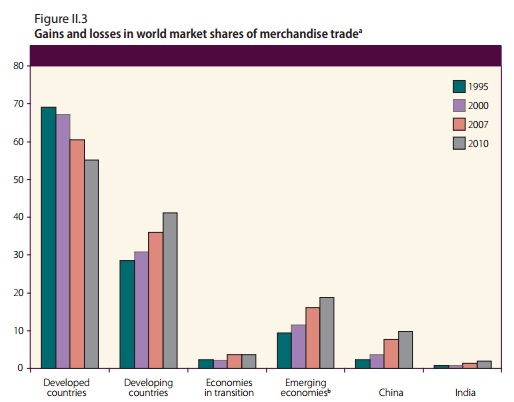
The world is globalizing at an incredible rate, and is poised to continue to grow in that direction. Since 1995 there has been a dramatic growth in international trade by all countries except for industrialized one (who lost a portion of the international market to developing nations). This indicates that trade is starting to spread more evenly between all nations, instead of the industrialized nations taking up such a large potion of international trade. It is in the field of international trade that bitcoin offers some of its most powerful benefits.

Because bitcoin exist ‘in between’ national boundaries, it is not subject to many of the restrictions that fiat capital is subject to. This means that people and business that are working across boarders can choose to use bitcoin, and avoid national taxes, capital controls, and the intense oversight that is forced onto people and business from governments. Furthermore, when using bitcoin one does not need to deal with changing currencies consistently, and the associated fees and taxes that come with that.

Innovation vs. Crony Capitalism

Bitcoin is clearly a superior currency to its fiat counterparts. This is because Satoshi took all of the best features of both the internet and money and imbued them into one to create the first digital currency: Bitcoin. Bitcoin automates most of the processes that governments, laws, and the banks preform to maintain the money system. This means that the users of bitcoin do not have financially support the very large cost of maintaining a fiat monetary system. The innovative way that bitcoin secures money, protects identity, and allows for transfer to anyone with a internet connection is much more efficient than any monetary system today. With bitcoin, your money belongs to you, and you are the only one with control over it. Hands-down, this makes bitcoin win the economic argument by being more efficient, quicker, and secure.

But the economic argument has nothing to do with what we are talking about though…. because money is NOT about money.

It’s about politics.

Bitcoin is a massive threat to those that are already in political power  and the special interest groups that pay them. We are at this interesting crossroads where we all know that bitcoin cannot be stopped, yet it clearly threatens the current financial and governmental infrastructure. What fascinates me about this is that it forces states into a prisoner’s dilemma against one another that they cannot win.  The countries that have a clear, succinct, and friendly policy towards bitcoin first shall be the one to win the most economic benefits of bitcoin, and the ones that fail to do so shall lose the most. This is on top of the fact that bitcoin is superior to every country’s fiat money–there simply is no way fiat currencies can ever win over bitcoin. States will have to acknowledge and accept digital currencies as real legal tender, or they will have to suffer the consequences of using a money that is more expensive to use, subject to inflation, can be seized at any point in time, and is forced to pay taxes on it, and is subject to banking fees. At the end of the day, bitcoin is just better money, and it will take over the financial system because of that.

Next: The Creative Destruction of Bitcoin


Confessions of an International Wire Banker

I work at a bank and I am in charge of the operations side of handling international wires. Granted, I have no power in the decision making process of how things are done, which is really too bad because I just have to watch the bank I work at, and the customers that I am servicing throw away good money on a shitty service. Part of this is the bank’s fault, but I have to empathize a bit, because most of the decision is not within our hands, but is from new international wire regulations handed down by the federal government. Sadly, we act as an extension of the state, instead of seeing ourselves as a counter-balance against the state. This means that when approaching issues, we are more prone to “play it safe,” than to try something new and risk upsetting the masters of money: the government.

So, just how inefficient am I talking here?

Well, first we need to do all of the Know Your Customer (KYC) requirements. This involves the paperwork that has all of your personal information, banking information at both institutions, and physical signatures (i.e. not a faxed copy) on the paperwork, in addition to any of the extra required information for ‘special countries’ like India or Taiwan. This is probably also a good time to point out that you cannot send money to a good 50 or so countries that are in the global south, or are ‘developing’ such as Kenya or Albania. Once this is all completed we need to verify all of the information, and then complete sending all of the paperwork. This whole process takes about 30 minutes from when someone sits down, to when they leave. (Note: these are the requirements for my bank, which are not necessarily a reflection of the new international wire rules).

Now, on top of all of this there are a number of restrictions:

  • You cannot send more than $25,000 at one time.
  • You cannot send more than $50,000 within a 6 month timespan.
  • We can refuse any wires that we ‘don’t feel comfortable with,’–whatever that means.
  • It will take at least 3 business days and up to 14 business days.

There are also the fees:

  • 1% currency conversion transaction fee.
  • Outgoing International wire fee of $35.
  • Any inbound wire fees (ranges from $10 to $30 dollars) at the other institution.

Finally, there is also the errors that occur:

  • Wires going to the wrong place
  • Missing the cut off time
  • Initialed or sign the wrong place
  • Faxed the signature instead of getting a physical one
  • Having the wrong address, IBAN, beneficiary name
  • Anything literally getting lost in translation

Now when you look at all of the associated cost with maintaining this process, you can see that using bitcoin, or any other digital currency for that matter, is magnitudes more efficient. It is more efficient in the following ways:

  • Transaction fee that is less that 10 cents
  • Transfer is completed in less than an hour
  • Transfer is done securely
  • Many fewer failure points (there is only one address to get wrong with bitcoin, whereas there are pages of information to get wrong with wires)
  • No 1% converstion fee
  • No maximum limits
  • Privacy
  • No need to answer questions for the government or reveal your identity.

What makes me the most frustrated is that I really feel for my customers. They need to get money somewhere for many different reasons–which is none of my business, or anyone else for that matter–but they can’t from all of these asinine rules, regulations, and safety procedures that do nothing other than create artificial capital controls.

So what gives? What is with all of this stupidity?

The banking industry is not independent in any way, shape, or form from the government. It is an organization that exist because the state allows it to in exchange for complying to the heavily regulations that are demand of banks. In fact, most banks spend more than 1/3 of their budgets on federal regulation compliance, and even that amount is not enough. In reality, banks are some sort of quasi state-private enterprise that exists at the behest of the State. Most people here never question it; for them, it is just a fact of life.

The bank exist because the State allows it to, which means that the bank’s existences is owed to the state, which means that being complaint with the state will always supersede being efficient. This is how we arrived at this place of being incredibly inefficient:

It does not matter if banks are inefficient because they are granted a portion of the states monopoly on money through being complaint with their demands–NOT from being efficient for their customers.

This in turn has created a ‘culture of safety’ where ensuring and upholding the illusion the state has handed us is much, much more important than taking a risk of upsetting the state to make our business operations more efficient. Why go out on a limb when you can risk your status as a bank? Thus, it becomes easier to create the company line that we have to charge exhortation rates and create stupid restrictions because of the need for ‘safety’ and ‘complacency’ handed down from the state, than to try something new and innovative, but risking upsetting the ‘nature order’ of things.

Conclusion 

I work in this industry because I am trying to understand it and what is so wrong with it. I am learning this industry inside and out so that when the time comes, I will know my enemy and know the quickest path to their defeat. The hope is there will be no great battle, no epic war–the banking industry simply and slowly convert to digital currencies, forced to do so from the simply fact that bitcoin just is better money.

For now, I am quietly waiting, watching, and observing… There will be some point soon where my knowledge will assist in helping digital currencies defeat this anachronistic system that has no place in a digital world.

The Hope of Bitcoin

The world is a screwed up place and things for many do not seem to be getting better. The U.S. Federal government is dysfunctional beyond repair, with 85% of Americans disapprove of Congress, and the total integrity of the United States being called into questing from the President’s repeated lies and support for the NSA spying. Food Stamp usage is at an all-time high with nearly 48 million people on food stamps, which even that the federal government is slashing that program back, Mean while, it is becoming more and more clear that the Federal Reserve may not be able to service their $4 Trillion dollar deficit, and may also need a tax payer bail out. All in all, the United States is has monumental problems in front of it, and there is no one to lead us out of this mess. We are Screwed.
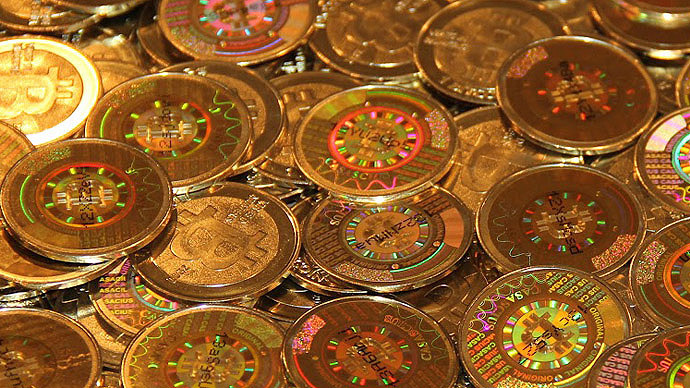
The Global Stage

The Global stage looks even more bleak. Europe is clearly entering into another major depression, with deflationary pressure forcing down the value of the Euro. Considering that some countries already have +20% unemployment, Europe is entering into a more major and sever economic crisis than the one it is in today. China is bloated with foreign currency loans, which could easily spin out of control and drag the west down with it. The Indian economy is the weakest it has been in 10 years, and does not look like it shall be recovering soon. Argentina is also looking at getting back on the currency crisis merry-go-round, with their foreign currency reserves dwindling and confidence plummeting. All in all, the global economy looks like it is heading for another Great Depression.

Thank God for Bitcoin

Despite all of these horrors going on in the world, I’ve seen my savings increase by more than 200% in the last year–and it looks poised to go up another 200% over the next year. Bitcoin as a storage of wealth I believe to be a relatively safe investment because of its liquidity–I can cash out all of my savings in less than an hour–though I never world. Bitcoin is just too good of a savings instrument in a world where governments can legally allow for banks to steal from you. It is clear that the majority of the governments in the world are nepotistic, corrupt, oligarchic alliances among corporations, bankers, and crooked politicians, who have no interest in you, your friends, family, community, or economic prosperity.

That is why bitcoin is so powerful–it takes back the power of having independent money that cannot be controlled or manipulated. This is money that has value because of its utility of being able to send money anywhere in the world in under one hour, but also from its built-in scarcity. You have the assurance of knowing that there will only ever be 21 million bitcoins created, and you can also know what the monetary supply will be at any point in time. This means that bitcoins are pretty much impossible to counterfeit.

All of the powerful features of bitcoin that got it to the success that we are seeing today is part of what makes it such a powerful savings vehicle. For the first time in one hundred years, people have a commodity money that is not controlled by the state, or their corrupt allies. There is a huge and powerful opportunity for those of us that are involved in the globalized society that is the internet, to create our own economic prosperity together. It is clear that we are doing that with the epic rise in the price of each bitcoin, along with the multitude of products, services, and number of business that are starting to accept bitcoins.

What indicates to me that this is not a bubble is that there is very, very real cost savings that bitcoin is offering. So much so that bitcoin has an almost-zero transaction cost, and when compared to fiat currencies, it has a negative transaction cost! It is obvious for anyone who looks at the macroeconomic statistics of what the cost of governance is compared to bitcoin, which has no cost of governance. Thus we find ourselves using a currency that is simply more efficient in all ways over fiat currency.

Final thoughts

Everyone, even those heavily involved in bitcoin generally say, “Only invest that which you can afford to lose.” I agree to an extent. Where I disagree is the idea that your 401K, savings account, or cash in hand is any safer. It’s not, and frankly over the next 10 years, I would call those investments dangerous. Simply look at what has happened over the last 5 years, and look at the direction we are heading for the next 5 years. Things are NOT looking up, and investing with the vast majority of the world means that you will stuck in their luxury liner as it is going down. The global economy is slowing down faster than it has any time in modern history. The days of 4% unemployment will never return–we have reached the end of growth, and when the house of cards falls, it will be spectacular. For your own safety, I advise everyone to invest just $100 and see what it does for you over the next 6 months. Just watch it and see what you think at the end of the 6 months, I guarantee you will be happy with yourself.